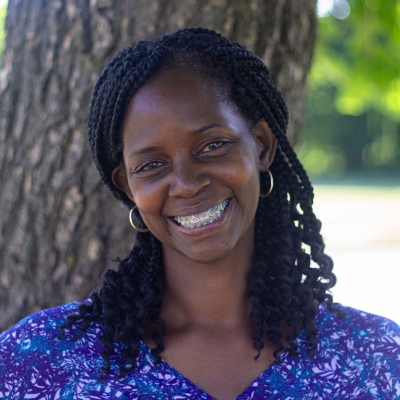
This blog follows the success story of Katrina Watkins, a 2021 Walking College fellow who founded the Bailey Park Neighborhood Development Corporation to improve her neighborhood and engage the community of Detroit, Michigan.
In 2014, Katrina Watkins grew increasingly frustrated each time she looked out at her street.
Located in the McDougall-Hunt neighborhood — just one mile from downtown Detroit — the area had suffered from years of disinvestment. Across from her home, the vacant lots stood neglected: overgrown with weeds, filled with dead trees and debris, and ignored, she said, by the City of Detroit. What should have been an open, welcoming green space had instead become a hotbed for drug activity and prostitution, creating an unsafe passage for children who had to walk by on their way to the community center.
For Katrina, it wasn’t just an eyesore; it was a daily reminder that her neighborhood deserved better.
In July of that year, a chance encounter changed her life — and the future of her neighborhood. She met two University of Detroit students who were looking for a subject for their capstone project. They had heard that her father, Willie Watkins, had lived in the historic Black Bottom neighborhood and came to interview him.
Black Bottom was once the beating heart of Detroit’s African American community — a place where Black-owned businesses thrived, families built stability, and culture flourished. Jazz spilled from the clubs, churches anchored the community, and neighbors looked out for one another.
“We are working together with the residents to create change. A lot of the ideas come from the residents and not me. There are some really smart, creative people in this neighborhood.”
– Katrina Watkins, Founder and CEO of Bailey Park Neighborhood Development Corporation and 2021 Walking College Alumn
But by the mid-20th century, Black Bottom was torn apart by so-called “urban renewal.” Homes were razed, families displaced, and the thriving neighborhood was erased in the name of progress. The echoes of that destruction carried forward for generations, leaving scars across the city and in the lives of those who once called it home.
On their way out the door, Katrina said the students turned to her and asked a simple but powerful question: “What is your hope for this neighborhood?” Without hesitation, she shared her vision — to clean up the vacant, overgrown lots across the street from her home.
That simple conversation planted the seed for something far greater than Katrina could have imagined. The students listened intently, inspired by her determination to reclaim her block from decay. What began as a casual exchange soon transformed into the focus of their Capstone Project. Together, they began mapping out possibilities — researching resources, developing a plan, and rallying support.
By the end of the year, Katrina had formed her nonprofit, The Bailey Park Project, and the partnership gave birth to the F.R.E.E. Project (Framework and Resources for Empowering Environments) — a blueprint for community engagement and neighborhood revitalization in Detroit.
Eleven years after Katrina first set out to clean up her block, that spark of determination has grown into something much bigger — a movement centered on housing stability, sustainability, and community well-being.

In 2020, her organization acquired a vacant three-bedroom home and transformed it into a Community Resilience Hub. What was once an empty house now hums with life, serving as headquarters for the four-person staff and contractors, and, Katrina said, the heartbeat of the neighborhood. Inside and beyond its walls, the Hub offers a tool library for residents, runs a landscaping business that employs neighbors, and provides no-cost minor home repairs and energy-efficiency assistance. Fresh produce is delivered to families in need, workforce development programs open pathways to opportunity, and new ideas for community support take root almost every season. The work has grown so rapidly that plans are already underway for a larger facility to keep up with the vision.
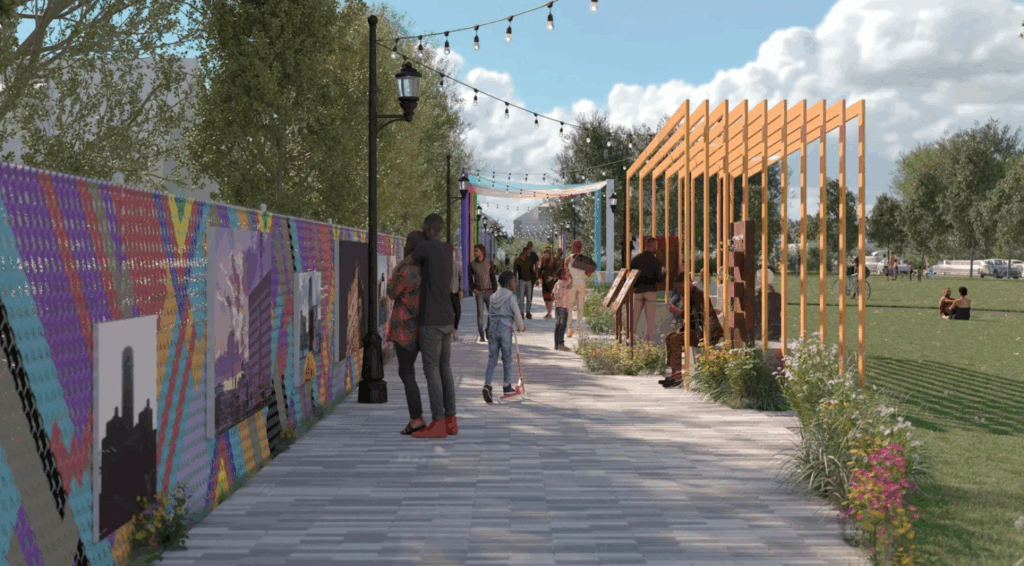
At the center of it all is Bailey Park, the organization’s cornerstone project. In 2018, 23 long-neglected lots were reborn as a vibrant community park — a transformation that came with an investment of roughly $700,000, largely supported by grants from partners like The Kresge Foundation. Today, Katrina says the park stands as a living testament to resilience, creativity, and persistence, offering beauty, safety, and belonging where blight once reigned. It remains one of her proudest achievements, though she is quick to credit the neighborhood itself.
“We are working together with the residents to create change,” she says. “A lot of the ideas come from the residents and not me. There are some really smart, creative people in this neighborhood.”
This publication was made possible by the Centers for Disease Control and Prevention (CDC) (Contract #47QRAA20D003W). Its contents are solely the responsibility of the authors and do not necessarily represent the official views of CDC. These efforts are part of the CDC’s Active People, Healthy NationSM Initiative that is working to help 27 million Americans become more physically active by 2027.