Commentary authored by Matilda Bekoe.
Each October, National Pedestrian Safety Month encourages transportation agencies and safety organizations to remind motorists to slow down and watch for people walking.
In 2024, 7,080 pedestrians were killed in traffic crashes across the United States, according to the National Highway Traffic Safety Administration. More than 71,000 were injured. That amounts to approximately one pedestrian death every 74 minutes.
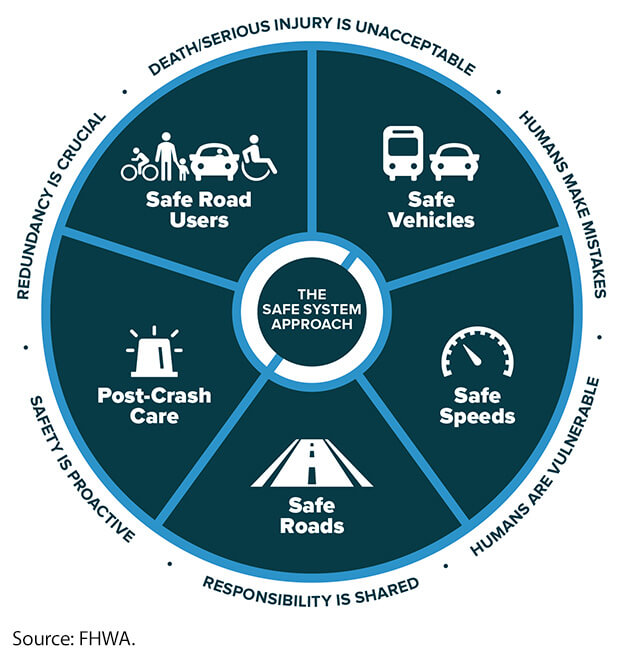
These figures have renewed attention to the many elements of pedestrian safety. NHTSA describes its Safe System Approach as including safer people, safer roads, safer vehicles, safer speeds, and effective care after crashes. Driver education belongs within that broader conversation.
Awareness campaigns can encourage caution, but their messages often fade after the campaign ends. Pedestrian safety education should also be connected to a moment that reaches nearly every motorist. Driver’s license renewal provides that opportunity. It is also a practical setting for explaining rules that have changed since a motorist first learned to drive and for correcting common misunderstandings about pedestrian spaces.
Preventing pedestrian deaths requires safer crossings, lower speeds, better lighting, accessible infrastructure, and effective enforcement. Yet another potentially valuable intervention receives far less attention. Governments seldom reassess what drivers know or provide structured opportunities to update that knowledge.
An everyday driveway encounter illustrates the problem. A driver may reverse while watching for approaching vehicles but fail to check the sidewalk for a child riding a bicycle, an older adult walking, or a person using a wheelchair. Using federal crash data collected from 2002 through 2007, NHTSA estimated that backover crashes involving all vehicle types resulted in approximately 292 deaths and 18,000 injuries annually. In that same estimate, children younger than five accounted for 35 percent of the fatalities, while adults aged 70 and older accounted for 26 percent.
These incidents are difficult to track because many occur on private property, including driveways and parking lots, and may not be fully represented in standard roadway-crash databases. Backovers represent only one part of the wider pedestrian-safety problem, but they demonstrate how routine driving situations can expose serious gaps in awareness.
Those gaps have become more consequential as streets have changed. Communities have introduced bicycle lanes, raised crossings, pedestrian-refuge islands, and traffic calming features. These designs may not have existed when many motorists were originally tested. Electric bicycles and scooters have also created new interactions.
Traffic laws and recommended practices continue to evolve. However, in many states, license renewal remains largely an administrative process involving documentation, vision screening, and payment of a fee.
Hawaii’s experience demonstrates how lawmakers are beginning to examine this issue. During its 2026 session, the Hawaii’s Legislature considered House Bill 2020, which proposed requiring certain license-renewal applicants to complete a road-safety course and written examination. It also would have authorized random written testing of other applicants.
The House passed one version of the bill on March 10, 2026. The Senate subsequently amended the proposal and passed it on April 14. Two days later, the House formally disagreed with the Senate amendments, and the chambers did not approve a final version before the measure died. Although the proposal was not enacted, it raised an important national question. Should renewing a driver’s license also involve renewing essential safety knowledge?
States do not need to require another full road test. A brief online module could address crossings, driveways, bicycle lanes, nighttime visibility, and interactions with emerging transportation modes. Scenario-based questions could test practical judgment instead of memorization. States could make the module universal or target it according to driving history.
Education alone cannot end pedestrian deaths. Communities still need safer streets and meaningful enforcement. Nevertheless, renewal gives state governments recurring contact with nearly every motorist. That contact is an underused educational opportunity. A renewed license should represent more than permission to continue driving. It should reflect a renewed understanding of the responsibility that driving requires.
Matilda Ohenewaa Bekoe is a PhD student in Geography in the Department of Geography and Environmental Studies at New Mexico State University. Her research focuses on active travel, walkability, transportation equity, environmental justice, and creating safer mobility environments for children and communities.