

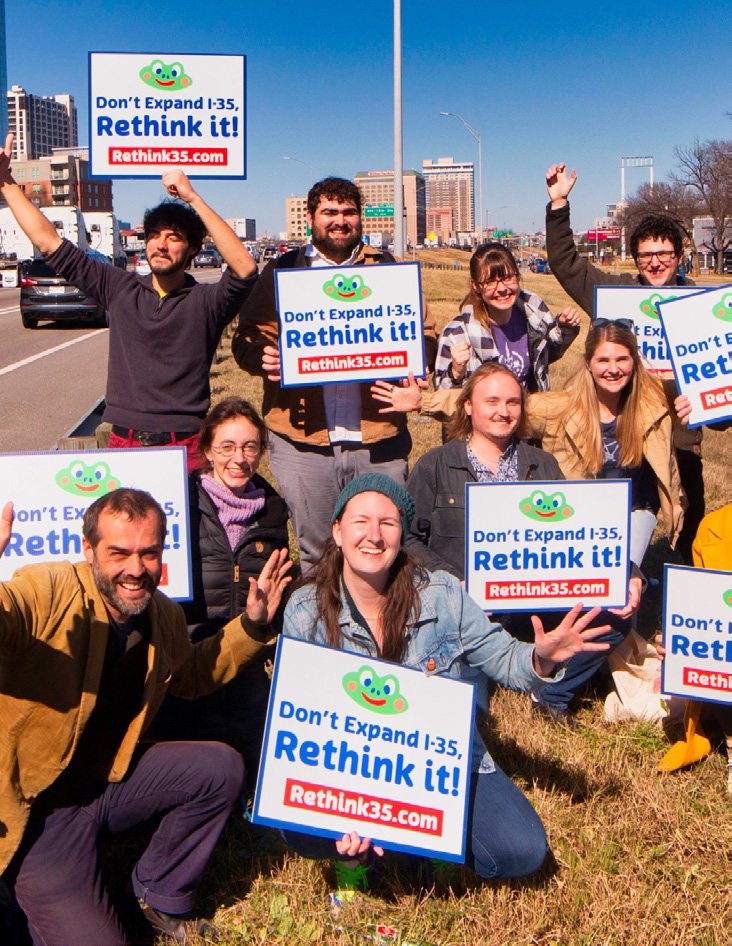
A starting guide for freeway fighters
For community organizers working to stop highway expansion or reconnect neighborhoods divided by highways.
Download the Playbook (PDF) Join the Freeway Fighters Network
A highway harms your community. Now what?
Countless communities across the United States are split in half by highways. When they’re built through communities, highways become barriers, dividing and polluting cities, towns, and neighborhoods.
Many people become freeway fighters when they decide their community is better off without a big road. Maybe a plan to expand or extend a highway spurs them to action. Maybe an existing highway has reached the end of its life and there’s an opportunity to reexamine whether it is needed.
This playbook is for early-stage community organizers seeking to protect their communities from highway expansion, or to reconnect communities divided by highways. It’s a starting point for understanding the bureaucratic and legal process that guides highway building and the organizing strategies that can shape freeway fights, with case studies from urban and rural campaigns. It is not a comprehensive guide to the political context and laws of every state.
Some material is more relevant to fighting expansion, some to reconnecting communities, and there’s often significant overlap. Throughout, the playbook will help you make the case for a positive vision: highways have many harmful effects you’ll want to emphasize, but a vision that leaves your community stronger is what wins hearts and minds.
1. Are You an Organizer?
If you have ever rallied everyone to get out of the house to school or an event, you are an organizer. If you have ever gotten a group to agree on a restaurant or what’s for dinner, you are an organizer. We are all called upon at one time or another to organize others to action.
Can you organize to stop or remove a highway? We’re not going to sugarcoat this: it will be hard. But it has been done before by people like you.
We start with organizing because it is the asymmetric strategy that can overcome the monetary and institutional power historically behind highway expansion. Departments of Transportation have access to hundreds of millions of dollars to push and develop projects. You need to find another way to counter these resources.
Organizing has been defined as “using what you have to get what you want”: working with others to identify messaging, strategy, and tactics that tap into the latent power in the community to move toward a common vision.
Organizing helps people realize their own agency in the community, moving them from:
Head
“I know what is right.”
Heart
“I want to change this.”
Hands
“I will take these actions to create the changes my community needs.”
Organizing, therefore, is about relationships.
Organizing is about equipping people with the power they need to change their world. It is about relationships… It is not about marketing, it is not about sales, it is not about crowds. It is about commitment to one another.
Marshall Ganz
This playbook will walk you through developing a movement and campaign strategy, the key moments in fighting a highway project, and tactics that people like you have used. It isn’t the last word, but each section links to resources so you can go deeper.
You don’t have to do this alone
America Walks stewards the Freeway Fighters Network, which exists to exchange information and support freeway fighters across the country.
2. Making the Case for Your Movement
One of the most important first steps is to define the vision and values of your movement, center it in community values, and explain the choice confronting the community. This is called public narrative, and it has three elements:
- Story of self: why you are engaged.
- Story of us: how the community has confronted similar challenges, and why it must confront this one.
- Story of now: that the community, working together, can build a better future. It references your strategy (your campaign plan) and includes a call to action: how an individual can have agency within the broader movement.
We owe a debt here to Marshall Ganz, and encourage you to learn more about him and public narrative.
But let’s start with you. Why are you engaged in freeway fighting, and why should others join you? Answering this question, sharing it, and learning about others’ vision and values is the starting point for building a team, a movement, and coalitions.
Story of Self
A Story of Self is a personal narrative that communicates who you are, the values that drive you, and the choices that shaped you. It centers on “choice points” (moments of challenge, decision, and outcome) that explain your motivations and build empathy and trust.
As you develop your Story of Self, reflect on these questions:
- Why am I called to this movement?
- Why did I decide to tackle this specific injustice or problem and work on this organizing effort?
- What values move me to act? Have these values always been important to me? If not, when did that change?
- How might these values inspire others to similar action? What stories from my own life, about specific people or events, would show rather than tell how I learned or acted on those values?
Your story, and all of your messaging, should appeal to the heart as well as the head. It’s common to lead with the analytical, data-driven reasons highways are bad for health, safety, the environment, and the economy. But politics runs on emotion, not logic. Include the personal reasons that motivate you, like the effect of a highway on family, friends, or neighbors you saw harmed by past choices.
Then try it out. Set up one-on-one meetings with other community members, draw out their story of self (everyone has one), and share your own. These conversations are crucial. Without others, you are a gadfly. With others, you are part of a movement.
The Story of Us: Establishing a Vision and Shared Values
What is the shared vision for your community if the movement succeeds? A vision can describe physical changes (no expansion of I-35, or I-81 through the city replaced by a boulevard), but ideally it is outcomes-based as well. Here are the visions of two contemporary freeway fighting movements:
Stop TxDOT I-45 · Houston, TX
Mission: “To challenge the status quo of transportation policy and to fight for all people in Houston to be able to participate in the decisions that affect health, safety, and mobility in their communities.”
Vision: “We envision a future where transportation serves as a joyful connective tissue that moves all people safely and freely through a healthy, healing environment.”
Oklahomans for Responsible Transportation · Norman, OK
“Our mission is more than just protecting our homes; it’s about looking out for what is best for Oklahoma, our state we love so much. We look to ensure future generations do not fall victim to the mistakes of the past…
We stand for individual property rights free of government overreach. When roads are properly planned and financed, we not only protect and preserve our agriculture, public and private lands, water, and wildlife, but we also trust we are passing on a fiscally responsible government to our children and future generations.”
Both movements oppose highway expansion, but both visions encompass more than a transportation decision. For Stop TxDOT I-45, it’s about a safer, healthier, more joyful community. For Oklahomans for Responsible Transportation, it’s about protecting homes and nature, and stewardship for future generations.
Your vision doesn’t need to be static. It may start with an individual or a core group, but establish a dialogue with the broader community early and incorporate the concerns and dreams you hear. That way you set a common goal without prescribing exact solutions, and a broad vision helps people see themselves as part of the movement.
Root your vision in a set of shared values. Think of them as your movement’s business card: they should convey in a word or two who you are and what you stand for. Ideally, they’re reflected in your movement’s name.
The Story of Now
You know why you are engaged, and you’re working with others. What is the plan? When you ask people to join, what is the specific ask?
People have to make choices with their time. Even if they share your values and goals, they need to know there’s a strategy reasonably calculated to win. At the start, your ask may be as simple as “can we work together on this?” But once you have a core group of committed people, it’s time to sit down together and write a campaign plan.
Remember: if it isn’t written down, it isn’t a plan.
3. Writing a Campaign Plan
A campaign is a series of linked tactics to achieve an objective. If one phone call or letter could solve the problems you see, you wouldn’t be here. If the logic of your position hasn’t swayed decision makers or the public on its own, a campaign is required. Campaigns may start with one theory of change, but they’re also about building the collective capacity to adapt to changing circumstances and find a new path to your objectives.
A campaign can also be a series of nested campaigns. In the civil rights movement of the 1960s, the overriding objective was establishing civil rights in federal law. The Selma march and the Montgomery bus boycott were nested campaigns that won real change while building power and momentum toward the ultimate goal.
In a freeway fight where the ultimate decision rests with the legislature, nested campaigns might include driving comments on an Environmental Impact Statement (EIS), winning over a city council, or securing a legal pause. Each is an opportunity to build power by winning more supporters, and each needs its own plan.
When putting together a plan, consider these ten elements:
1. Who are your people, and what do they want?
Who are the people in your community you’re committed to working with? What challenges do they face, and what kind of change do they need? The answers come not from an academic study but from talking to people about their lived experience. Ultimately, ask: “How can I enable them to use their resources in new ways to develop the power and capacity they need to accomplish their goals?” This is how you start the outreach to understand community concerns, discover work already under way, and find people to plan with.
2. What are the goals of the plan?
Goals should speak to both a longer-term vision (e.g., replace the highway with a true community vision) and a specific, measurable outcome. This is where your team identifies interim and long-term goals, and the nested campaigns within the broader campaign.
Include goals for organizational and personal growth, too. Whether or not the plan succeeds, you should be building a base for further action. Personal goals might include new relationships or skills. Organizational goals might include new volunteers, more diverse leadership, or new coalition partners.
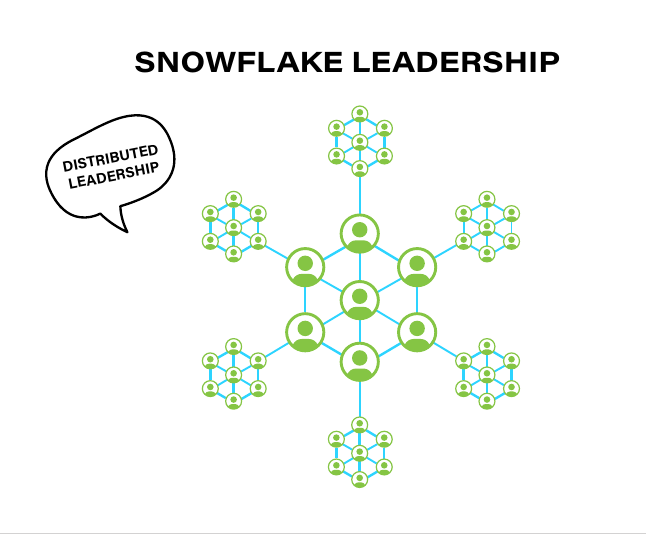
We urge your core group to adopt the “snowflake model” of organizing. Hierarchical structures can lead to burnout and low engagement. In the snowflake model, leadership is distributed among multiple people, each empowered to act in their own area, defined geographically (by neighborhood or region), thematically (outreach, digital communications, technical assistance), or another way. The goal isn’t just to recruit followers to do work, but to develop leaders who develop further leaders, expanding outward like a snowflake.
3. Who has the power to give you what you want?
Are there specific people who must act for you to achieve your goals? Who are they, and what must they do? Be specific. Distinguish between those who influence policy and those who actually have decision-making authority. You want the first as allies, but the decision makers are your ultimate target.
Decision makers vary by state, and alongside formal processes there are informal ones that determine who has the authority to give you what you want. See How Do Highway Plans Get Made? below.
4. What are the values driving your plan?
Clearly identified values shape your campaign message and how you do your work. They also build a bridge to the next stage: specific issues and opportunities change, but values endure.
5. What is your theory of change?
Campaigns are about using what you have to win the goals you seek. A clear theory of how to get from here to there makes it easier to attract others to your cause. For example:
By demonstrating broad local opposition we will win local elected officials and influencers to our cause, ultimately convincing the legislature to abandon the project.
6. Campaign narrative
What story will you tell others about the plan? What are the key talking points? Is there a memorable slogan? Your story should illustrate your vision, values, and theory of change, as well as the outcome you want. Think about how it would be told to a reporter, on social media, or to a potential partner or volunteer. Is it easy to remember and repeat? Does it strike an emotional chord?
Keep it to a few paragraphs. This is where the story of us and the story of now come in.
7. Allies and opponents
Who might actively partner with you? Are there influencers who would support your cause, or a particular demographic you can or should reach? Will there be an active opponent, or people with reservations? Can you shape your message to win them over, soften their opposition, or make them less persuasive to people who start out neutral?
You probably can’t win everybody. You want to activate your supporters and persuade the undecided, so opponents understand that the community wants a different course. You’re on the far left of the spectrum below, the protagonists. You likely won’t change the minds of committed opponents. How do you move everyone else closer to you?
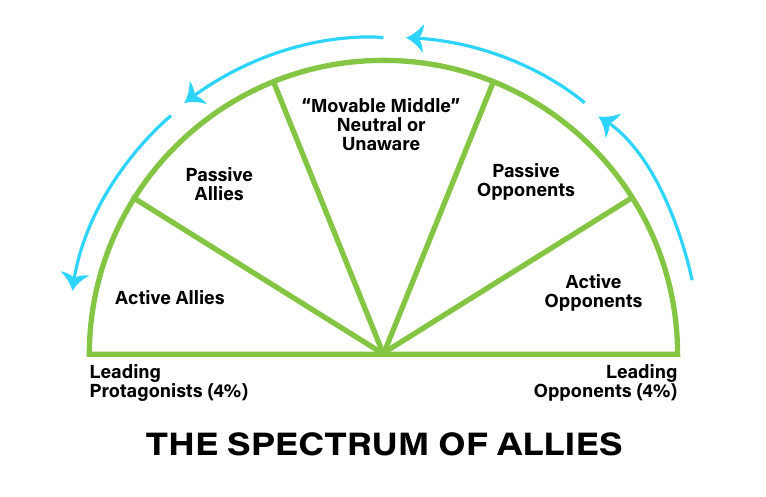
Broad coalitions are more effective at convincing decision makers, and relationships are key to building them. Find out who is aligned with your efforts and who else they could bring on board. What groups or institutions will be directly affected? Are there state or regional organizations that might support you? When you first reach out, set up a conversation and get to know each other before asking anyone to join your coalition.
Reasons others have opposed highway expansion or supported reconnecting communities:
- Protecting the environment
- Racial justice
- Responsible government spending
- Public health and air quality
- Protecting farmland
- Preserving and/or building homes
- Protecting private property
- Promoting walking, biking, and transit
- Community development
- Supporting local businesses
- Preserving parks and green spaces
8. Tactics and timeline
Identify the specific actions you’ll take and when. It’s hard to plan tactics more than 3–6 months out, and experience may show you need new ones. Your first goal might simply be gathering like-minded community members to develop tactics together, in which case list some potential tactics and treat the plan as a living document.
Keep your personal and organizational goals in mind: win or lose, you want to create new leaders and community will to make change. Choose tactics that engage others and are even fun. And definitely include a thank-you party for everyone who joined the campaign, no matter the outcome. See Tactics for Freeway Fighting for ideas.
9. Budget
Do you need a budget? If so, how much, and how will you raise it?
10. Volunteer recruitment and stewardship
Do you need volunteers? How will you recruit and engage them?
We can’t emphasize this enough: people come for the issue, but they stay for the people. What is your campaign doing to make it sticky for people, to make tactics meaningful, to demonstrate effectiveness, and to make time for fun and celebration?
Further resources
4. How Do Highway Plans Get Made?
Who decides whether a highway gets built, expanded, or removed?
Highway plans are typically formulated well before they receive public scrutiny. Many highways being built today were the gleam in a transportation planner’s eye decades ago. Since then, Departments of Transportation, state legislators, transportation commissions, local elected officials, Metropolitan Planning Organizations, highway contractors, affected businesses, and construction trade unions have been building support for the project.
Despite the flood of money for highway expansion, the main reason a given project hasn’t been built yet is that other projects are in line ahead of it. Proponents know that if they raise enough money, they can move further up the wish list. In fact, most road-building debates in the halls of power center on which project comes next, not on whether a project makes sense in the first place.
That makes it hard to identify who has the power to give you what you want, and states differ both legally and practically in how final decisions are made. You may rightly wonder whether the bureaucratic maze is intentional, shielding projects from real public scrutiny. But regardless of the specific state process, there are elected officials at the top with the formal or informal power to direct agencies to reverse their decisions. Address the agency processes below on their own terms, but also treat them as power-building opportunities to influence the ultimate political decision makers.
Start at the top
Highway projects are usually undertaken by a state Department of Transportation. Staff and administrators make lower-level decisions, but authority ultimately rests with the Secretary of Transportation (sometimes under another title), who answers to the Governor. The State Legislature controls funding.
- Some legislatures directly fund specific projects with line-item appropriations, leaving the DOT no discretion.
- Others delegate decisions to the DOT director, or to a Transportation Commission of appointed members.
- Some transportation commissions actually set budgets and priorities (e.g., Texas, Colorado, New Mexico).
- Others focus on long-range planning, policy advice, or tolling authority rather than day-to-day agency operations (e.g., Washington).
The big takeaway: you’ll need to spend some time understanding how decisions are made in your state. Who actually pulls the trigger on funding, who creates the project prioritization list, and who has the power to give you what you want? It also means there are many decision points along the way that you can influence.
5. Understanding the Highway Building Process
Building a highway in the United States is a long, multi-stage process involving government agencies, engineers, environmental specialists, contractors, and local communities. The exact process varies by state and project, but major projects generally follow common steps. For people seeking to stop or change a project, the key point is this: opportunities to influence it occur throughout the process, and generally narrow as the project moves toward construction.
A highway project becomes increasingly difficult to change as it progresses:
- Planning
- Funding
- Purpose & Need
- Environmental Review
- Preferred Alternative
- Final Design
- Land Acquisition
- Permits / Approvals
- Construction
1. Planning and Funding: Start Organizing Early
The process begins when transportation agencies identify a need, such as reducing congestion or improving capacity.
In most of the U.S., metropolitan planning organizations (MPOs) develop regional plans that feed into statewide long-range transportation plans. These outline specific projects the MPO and state DOT would like to build, and making it onto the MPO list is required for federal funding. Projects may also appear in the State Transportation Improvement Program (STIP), which identifies projects being considered or funded through federal, state, or local programs.
In the nearer term, an MPO’s Transportation Improvement Program (TIP) and the state’s STIP allocate federal funds to projects for at least the next four years. Highway projects that appear in these plans should be considered imminent and will likely move into a study phase for approval.
Long-range plans and TIPs help you forecast future projects in your neighborhood and region. It’s possible to amend these plans and stop projects while they’re still nascent and haven’t built momentum.
While the decision is made at the state level, local decision makers coming out against an expansion, or for a reconnecting communities project, is still incredibly useful. Mayors, county officials, and city councilors on your side can use their platforms and power to help convince decision makers at the state or MPO level.
When to act
This is one of the earliest and potentially most important opportunities for opposition. Start organizing as soon as a project appears in a regional or state plan, before major funding commitments are made. Attend MPO and transportation-agency meetings, submit public comments, contact elected officials, and advocate for funding to be redirected toward alternatives. Funding decisions aren’t necessarily irreversible: advocates can argue that money allocated to a highway should instead support transit, road maintenance, pedestrian infrastructure, or other needs.
2. The Environmental Review Process: Influence What Gets Studied
Once a project receives federal funding (as most highway projects do), its approval is governed by the National Environmental Policy Act (NEPA), which requires the agency to consider the project’s impact on the environment, including the human environment. Your state probably has its own equivalent. The agency will combine federal and state review, but it’s worth researching whether your state’s requirements are more favorable to your goals.
Agencies are legally required to follow the NEPA process, but NEPA does not require that a project with impacts be abandoned. As long as the agency has checked NEPA’s boxes, it can proceed. Highway agencies have become adept at using the process to reach the result they want, so early attention is essential.
NEPA is also one of the main avenues for legal challenge. Challenges are usually procedural (the agency didn’t follow the process correctly). Incorrect designations of Categorical Exclusions and Environmental Assessments (see below) can also be challenged.
Purpose and Need
Environmental and engineering studies generally begin with a Purpose and Need statement defining what the project is supposed to accomplish. If it’s narrowly focused, say, solely on increasing highway capacity, it can limit the alternatives considered later.
When to act
Get involved while the Purpose and Need is being developed. Push agencies to consider broader goals such as reducing vehicle dependence, improving transit, increasing safety, protecting neighborhoods, or supporting economic vitality. A broader definition can require the agency to evaluate alternatives other than expansion. Getting the agency to study removal as an alternative would be a major win: if it isn’t studied, the agency will later argue it can’t consider removal without restarting the entire environmental review. You might think it rational to consider the full range of alternatives, but the agency has an interest in narrowing them to projects it wants to build.
Environmental Review Documents
Once scope is defined, the agency prepares its environmental review documents. Depending on potential impacts, a project may receive:
- Categorical Exclusion (CE): essentially exempts the project from environmental review, because the agency doesn’t believe it will have an impact.
- Environmental Assessment (EA): a shorter review for projects the agency doesn’t believe will have a significant impact.
- Environmental Impact Statement (EIS): a full review for projects with significant impacts.
When to act
Pay close attention to the type of review. If a project receives a CE or EA when advocates believe a more extensive review is required, there may be administrative or legal avenues to challenge that decision.
Public Comment Periods
For projects requiring an EIS, review can take several years. Agencies may hold public meetings, publish draft documents, and request public comments.
When to act
This is a major period for organizing. Review environmental documents, identify shortcomings, provide evidence, organize residents to attend meetings, and submit detailed comments focused on specific issues and the alternatives the agency is legally required to consider. Issues must be raised in comments during the environmental review for the project to be challenged in court later on.
An environmental review generally evaluates a project’s impacts; completing it usually doesn’t mean those impacts must be eliminated. Its purpose is usually to inform decision makers, not compel a result. State environmental statutes may differ, so review yours.
3. Selection and Design: Push for Changes Before Plans Are Final
After environmental review, the agency selects a preferred alternative and develops increasingly detailed plans for the roadway, bridges, interchanges, drainage, signs, and lighting.
When to act
Keep participating after the preferred alternative is announced. Advocates can still push for the project to be redesigned, scaled back, or replaced with alternatives. Changes become harder once detailed engineering is complete, so early engagement remains important.
4. Right-of-Way Acquisition: Get Legal and Community Support
The government must obtain the land needed for construction, through negotiated purchases or, where legally authorized, eminent domain. This stage can create additional opportunities to question impacts and advocate for changes, though stopping the whole project may become harder once land acquisition is substantially under way.
When to act
If your property or neighborhood is affected, seek qualified legal advice as soon as right-of-way acquisition begins. Community groups can also organize affected property owners and monitor whether required procedures are being followed.
5. Permits, Approvals, and Contracting: Last Major Opportunities Before Construction
Before construction, the project must receive required approvals and permits. Agencies generally put construction out for competitive bidding and select a contractor under applicable procurement rules.
When to act
Monitor approvals and deadlines closely. If there are unresolved legal, environmental, permitting, or procedural issues, this can be an important point to seek administrative or judicial review. Once a construction contract is awarded, changing or canceling the project becomes substantially more difficult.
6. Construction: Monitor Compliance
Construction usually begins with clearing land, relocating utilities, and preparing the site, followed by excavation and grading, drainage and bridges, the road foundation, and finally pavement.
When to act
The primary opportunity may shift from stopping the project to monitoring whether construction follows approved plans, permits, environmental requirements, and other rules. Report potential violations through the appropriate government or regulatory channels, and document concerns carefully.
Summary: Timing Your Opposition
The earlier stages are generally the most important for people who want to stop or substantially change a highway. The strongest strategy is usually to begin organizing before major decisions are finalized, identify every formal opportunity for public participation, and keep monitoring the project through environmental review, funding, approvals, and construction. Because deadlines and legal rights vary by state and project, anyone considering a formal challenge should verify procedures and deadlines with the relevant agency or a qualified attorney.
Every step is also an organizing opportunity to build public awareness and show the ultimate decision makers, the governor and legislature, that it would be politically wise to pull the plug on funding or construction. Agencies can be quite impervious to criticism. Elected officials who face the voters may see the project differently with enough public opposition.
It’s never too late to stop a highway project
Proponents insist highway projects are inevitable, but that’s far from the case. There are many well-documented examples of highway projects withdrawn and even abandoned mid-construction.
Further resources
- A Citizen’s Guide to the National Environmental Policy Act
- Building Roads to a Just and Equitable Future (New York University School of Law)
- Litigation: An Underused Tool in Transportation Advocacy (The Funders Network)
6. Tactics for Freeway Fighting
Now that you understand organizing, campaigns, and the highway-building timeline, what actions can you take? Here are tactics contemporary freeway fighting groups across the country have used to advance their goals. Use them as inspiration for your own campaign.
Action Alert / Petition
Example: Rethink35, Austin, TX
A digital action alert spreads awareness, identifies supporters, and shows decision makers what public sentiment looks like. Rethink35 launched an action alert that has garnered over 10,000 signatures using Action Network, which has a free version. Action alerts also collect supporters’ email addresses so you can build a mailing list. Signatures can be collected in person too; just ask for an email address.
Coalition Letter / Press Release
Example: NJ Turnpike Trap, New Jersey
A coalition letter brings allied organizations together to make a specific ask of decision makers, showing strength in numbers and leveraging each member’s relationships. Just before Governor-Elect Mikie Sherrill took office in 2026, the NJ Turnpike Trap coalition wrote a coalition letter asking her to cancel a planned Turnpike expansion. Governor Sherrill canceled the project upon taking office. Pair coalition letters with a press release for exposure.
Local Press Interviews
Example: Coalition for Transit and Sustainable Development, Cincinnati, OH
Get to know your local reporters early so they come to you for stories about the highway. Look up who covers relevant topics and introduce yourself and your movement. Newsworthy stories often rely on tension, so use it in your pitch. Respond to interview requests quickly and connect reporters with other residents who share your view. See the coalition’s top tips for working with the media.
Town Hall
Example: No More Freeways, Portland, OR
Agency-hosted public meetings can be highly controlled, with limited room to voice public sentiment (though you should still encourage supporters to attend). Hosting your own town hall lets you shape the agenda and make sure community members have time to speak. When it became clear the Oregon DOT wouldn’t host an in-person hearing on the Rose Quarter I-5 expansion, No More Freeways held its own People’s Public Hearing in 2023, recording testimony and sharing it on social media.
Rally
Example: Rethink35, Austin, TX
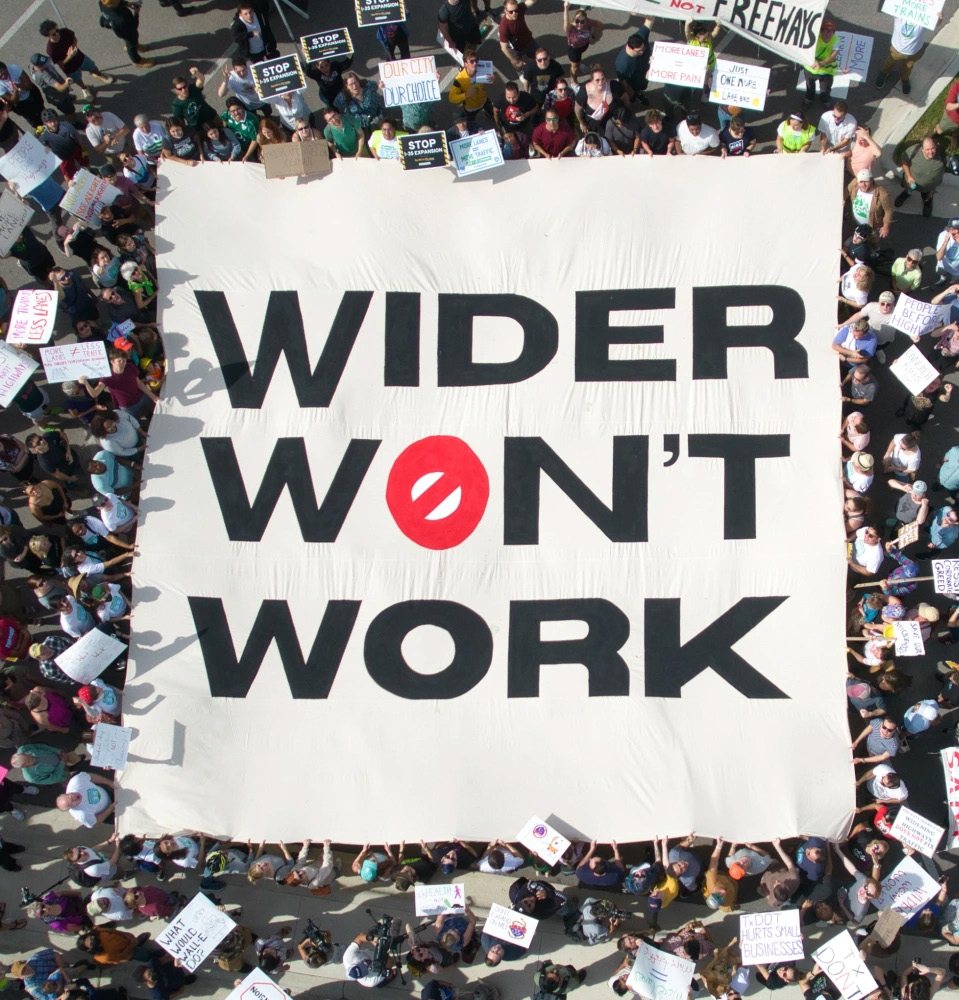
Rallies are highly visible events that bring hundreds of people together to support the movement, hear inspiring speakers, and have fun. Rethink35 hosted its Wider Won’t Work rally in 2023 in response to the state’s plan to widen I-35, featuring U.S. Representative Greg Casar and several Austin council members. Hundreds came out to the festival-like event, which drew significant local coverage. Rallies are resource-intensive and have the most impact once you’ve built a substantial base.
Block Party
Example: EVOAK!, Oakland, CA
A block party emphasizes fun and community, with less of a political component than a rally. It helps the general public get familiar with your movement without a specific ask. Hold it near the project site, and pair it with a temporary demonstration to help neighbors imagine alternatives. EVOAK! held the inaugural 980 Block Party in 2025 to reimagine the I-980 corridor through art, storytelling, and participatory design.
Temporary Demonstration
Example: Hinge Neighbors, Rochester, NY
Temporary demonstrations show what’s possible for a highway corridor through a temporary redesign. In 2022, Hinge Neighbors hosted Live on the Loop, closing the Scio Street Bridge over the Inner Loop for a day of music, games, activities, and food trucks that helped neighbors imagine the area without the Inner Loop.
Doorknocking
Example: Our Streets Minnesota, Twin Cities, MN
Doorknocking meets neighbors where they live: one-on-one conversations that reach people who may not know about your events or online presence. Our Streets Minnesota leads regular doorknocking campaigns about highway plans and has spoken with thousands of neighbors. It’s resource-intensive, but it builds a pipeline of supporters and a better read on public sentiment.
Billboard Campaign
Example: I-475 Neighborhoods Coalition, Toledo, OH
Billboards reach a broad segment of the public. The I-475 Neighborhoods Coalition took out billboard advertising explaining the costs of the I-475 expansion and the damage it would cause to neighborhoods, and paired the unveiling with a press release and rally.
Poster / Sticker Campaign
Example: Claiborne Avenue Alliance, New Orleans, LA
Like a billboard campaign, but smaller and more dispersed: posters or stickers with your message and branding on pylons and poles around the corridor. The Claiborne Avenue Alliance created a series of posters on the history of the Claiborne Expressway and the opportunity to restore Claiborne Avenue. Include a link or QR code to your digital presence, and have volunteers hand out stickers at events.
Social Media Campaign
Example: Stop TxDOT I-45, Houston, TX
Social media reaches many people quickly and can influence decision makers. Stop TxDOT I-45 uses social media to showcase community voices and victories through photo carousels, short-form video, and behind-the-scenes moments, spreads news about the project, and invites followers to in-person events (online-to-offline organizing). Its multilingual posts reach a wider audience. Followers can also be mobilized to message decision makers directly.
Fundraiser Dinner
Example: Oklahomans for Responsible Transportation, Norman, OK
A fundraiser raises money and builds community among supporters. Every year, Oklahomans for Responsible Transportation hosts a Chili Cookoff where people enter their chili to be judged by the crowd. Events like this build relationships, bring in people who may not know about your movement, and add the element of fun that keeps volunteers committed.
Lawsuits
Example: Fix at Six, Milwaukee, WI
Lawsuits are typically brought when an agency violates NEPA, the procedural law governing the steps an agency must take before a federally funded highway project (see the environmental review process). The Fix at Six coalition offers an example. Successful suits don’t cancel a project outright; they require the agency to redo its environmental reports. Their real power is the publicity they generate to galvanize supporters and reach decision makers. Lawsuits are expensive and require significant fundraising.
Candidate Questionnaire
Example: Mainers for Smarter Transportation, Gorham, ME
Questionnaires make candidates and incumbents take a public position, establishing who’s on your side and elevating the issue when voters are most engaged. Mainers for Smarter Transportation published a candidate questionnaire for Gorham town council elections. They’re especially effective in local races, where residents feel a project’s direct impact.
Polling
Example: Stop the Mid-States Corridor, Jasper, IN
Polling shows where the public stands and challenges the assumption that everyone wants, and is willing to pay for, highways. Polling commissioned by Stop the Mid-States Corridor found 72% of county voters strongly opposed the proposed Mid-States Corridor extension. Decision makers often use polling like this to decide what they will and won’t support.
Op-Eds
Example: Louisiana 4 Corners Coalition, Louisiana
Op-eds in a local newspaper or online outlet reach a wide readership and let you present a positive vision, identify problems with the status quo, and call on decision makers to act. Op-eds like this one from the Louisiana 4 Corners Coalition help set the public narrative and legitimize your viewpoint.
Show the Positive Vision
Example: Our Streets Minnesota, Twin Cities, MN
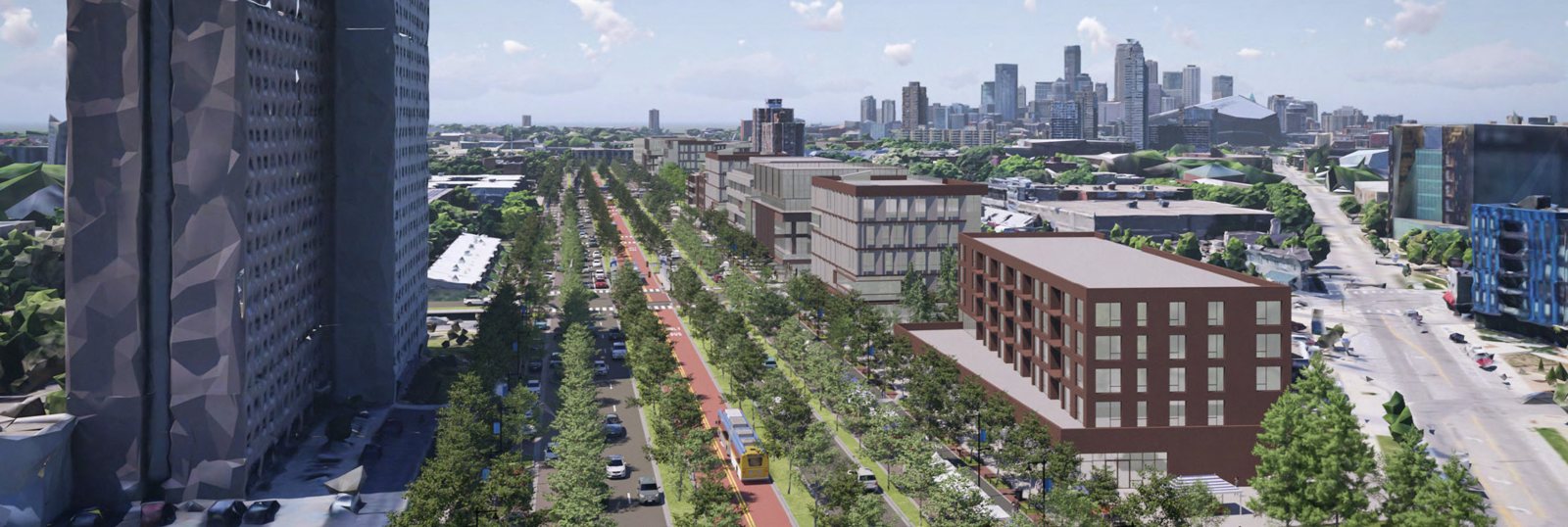
A positive vision draws supporters in and helps people imagine alternatives to the status quo, and renderings are especially powerful. Our Streets Minnesota commissioned Reimagining I-94, showing the corridor converted to a boulevard. Compared with the gray highway, the images emphasize vibrancy: people, trees, and new homes and businesses.
7. Frequently Asked Questions
Answers to the questions you’ll ask, and hear, most often in a freeway fight:
You’re not alone in this fight
Join the Freeway Fighters Network to trade ideas, get support, and connect with organizers fighting highways across the country. Download the full playbook to share with your core team.
Join the Freeway Fighters Network Download the Playbook (PDF)
Acknowledgements
Funding for the Communities Over Highways Organizing Playbook was generously provided by the Devou Good Foundation.
The primary authors are Ben Crowther, Policy Director at America Walks, and Mike McGinn, Executive Director at America Walks. Special thanks to Aaron Brown, Amy Stelly, Giancarlo Valdetaro, and Stephany Valdez, as well as all the participants and attendees at the 2023 and 2025 Communities Over Highways Summits, whose insights helped shape this playbook.

