

Design changes that slow cars and save lives
A plain-language guide for non-experts who want to make the streets in their community safer.
Why street design matters
If you are here, you’ve probably asked “what can we do about these cars speeding through our neighborhoods?” We hear you!
There are lots of options. You will likely discover that the biggest challenge is not technical, but political. But your starting point has to be exploring the potential design changes that make a difference.
This guide is where you can find information about the design elements that matter. It’s written for non-experts who want to know how to make streets safer in their communities.
For too long, communities have deferred to traffic engineers and experts who have prioritized vehicle speed over safety. Fortunately that is changing, both in evolving standards and in implementation. But there is a long way to go. If you are talking to traffic engineers or planners who tell you the status quo can’t be changed, we want you to have the best evidence to push back.
Each part stands alone, but they build on one another, so they’re worth reading in order.
In this guide
- Why Reducing Vehicle Speeds Matters to Pedestrian Safety
How the difference between 20 miles per hour and 40 miles per hour is a life and death issue for collisions with pedestrians. - Speed, Tunnel Vision, and Reaction Time
Understanding the physical challenge for people to read and react to their environment when traveling at speeds above 20 miles per hour. - How to Spot the Most Dangerous Roads in Your Community
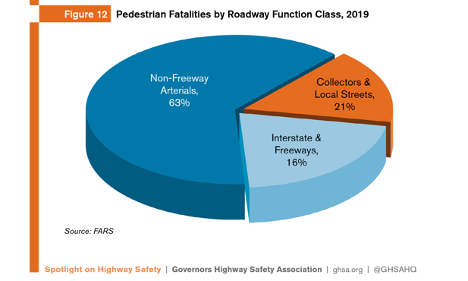
Data shows that most fatalities and serious injuries occur on multilane arterials that bring highway design principles into a mix of community uses. - How the Design of Corners Affects Speed
How a swooping curve induces dangerous speeds for those navigating crosswalks, and why a tight curve is a simple fix for safety. - Narrowing Lanes for Road Safety: Small Shift, Big Difference
How something as simple as repainting the lines on the street to create more narrow lanes can reduce speeds and increase safety.
1. Why Reducing Vehicle Speeds Matters to Pedestrian Safety
By Ian Thomas
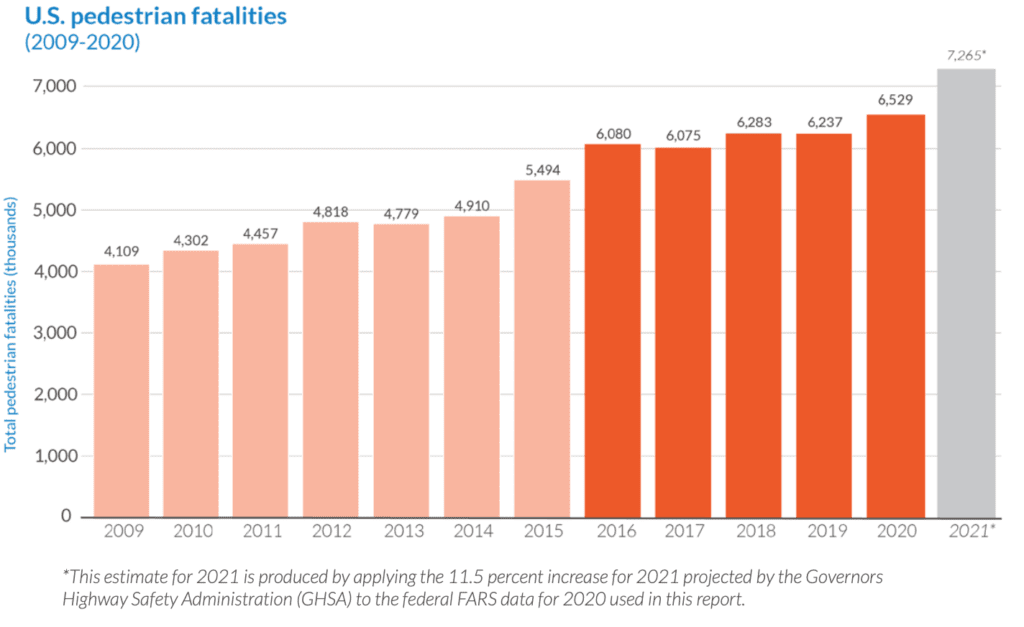
Over the last decade, annual pedestrian fatalities in the U.S. have increased by 52%. More than 6,500 people were killed while walking in 2020 and vehicle speed was a critical factor in every case.
How lower speeds save lives
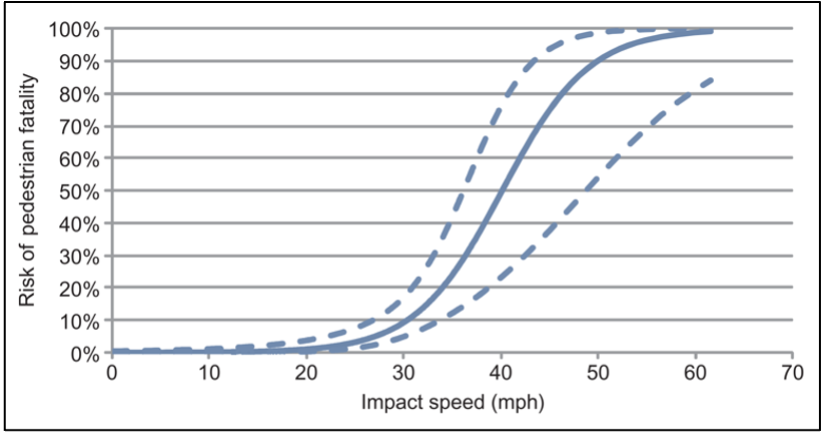
If a car moving at 20 miles per hour strikes a pedestrian, the probability that it will be a fatal collision is quite small – typically about 1 in every 40 incidents. However, the pedestrian is four times more likely to be killed if the vehicle’s speed is 30 mph, twenty times more likely at 40 mph, and the probability of death rises to 90% if the collision speed is 50 mph. And pedestrians are not the only road users made more vulnerable by higher speeds – bicyclists, wheelchair users, and occupants of vehicles are all much more likely to be killed or seriously injured in higher-speed collisions.
Therefore, a simple and effective safety strategy would be to reduce vehicle speeds on roadways where collisions are more likely.
That’s the starting point for this guide. The parts that follow discuss the interaction between speed and safety, bad designs that have made America’s roads so dangerous, and how we can modify them to reduce vehicle speeds and save lives.
This guide is written for the non-expert who wants to know what they can do to make streets safer in their community. For too long we have allowed street design to be the province of experts. But our streets are getting more dangerous for those outside of cars.
Streets are for everyone
While expertise is important, ultimately streets must reflect our values. And values belong to the community as a whole, not to the experts. The laws and technical manuals that govern street design for too long have prioritized the rapid movement of vehicles at the expense of safety and quality of life. This is even though the profession knows, from data, what actually works to make streets safe where people are present.
This guide works to demystify the technical aspects of street design, so that community members can push back against bad traffic engineering practices, and work for safer communities that are more accessible and inclusive. Which, by the way, is also a recipe for economic vitality and stronger community life.
2. Speed, Tunnel Vision, and Reaction Time
By Ian Thomas
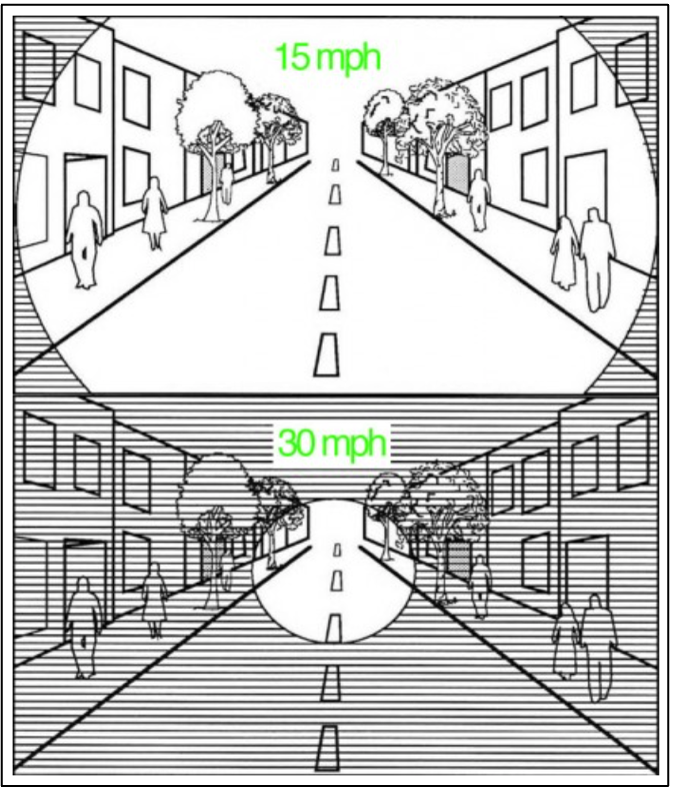
One specific way in which higher speeds impact safety, especially in complex driving environments, is through the effect of speed on a driver’s visual field.
When a vehicle is traveling slowly (say, 15 mph), the driver is able to receive and interpret a lot of visual information from the periphery of his or her field of view. Therefore, a child stepping off the curb or another car pulling out of a driveway would be picked up very quickly, allowing the driver to prevent a collision in most cases.
However, there is a limit to the rate at which the visual system and brain can process signals. At higher speeds, the vehicle travels a greater distance down the street in the same amount of time. Therefore, fewer visual signals from the periphery can be processed, and the child or car will not be seen so quickly.
When this reduction/delay in visual information is combined with the increased “stopping distance” due to the driver’s fixed reaction time and higher speed, there is an increased risk of a collision. And a high-speed collision is much more likely to cause fatalities.
This is less of a concern when driving in the more controlled environment of an interstate highway. The absence of pedestrians, driveways, cross streets, etc., intentionally simplifies the context. In other words, the narrower “cone of vision” at higher speeds is less of a problem because there is very little happening in the peripheral field of view.
Traffic engineers (and businesses near fast roads) know about your ability to process information at high speeds. Check out the size of the signs they put up as compared to local streets and how those signs are far in advance of the action they want you to take. They know you can’t process anything smaller, and certainly not quickly enough to change behavior in time.
Try this
You can test this phenomenon yourself. Stand at a corner, with or without a crosswalk, where auto speeds are slow, then stand at a corner where auto speeds are fast. On the calm street drivers are much more likely to slow down, make eye contact, and try to determine your intentions. On a fast street, they are much less likely to slow or stop, either because they don’t see you, or slowing or coming to a stop feels like a sudden action to them.
In more complex environments, that limitation on our ability to “read” our environment and react appropriately becomes a deadly problem. Attempts to control human behavior through education, enforcement, or exhortation will ultimately fail because humans simply are not perfectible in this way. The tragic consequences of normal human inattention or mistakes means we must design streets to slow traffic to sensible speeds when people outside of cars are present.
3. How to Spot the Most Dangerous Roads in Your Community
By Ian Thomas
Most people will tell you that safety should be the top priority when designing streets. However, if you ask a transportation engineer (whose professional responsibility is to design streets), you might hear concerns about traffic volumes or speed. Unfortunately, the concept of “free-flowing traffic” has become so embedded in the culture of this profession that speed is often prioritized over safety. And there is a trade-off. As discussed in Part 1 and Part 2: safety and speed are incompatible in complex environments which include driveways, intersections, turning movements, crossing movements, and vulnerable road users such as pedestrians, cyclists, and people using wheelchairs.
Unfortunately, design decisions that might make sense for limited access freeways – where pedestrians are not present – have been routinely incorporated into local streets and arterials. The tragic consequence is that most pedestrian fatalities occur on non-freeway arterials. Those are often multi-lane roads with high speeds going through commercial, retail, and residential areas. These can be on the edge of town, or right through the center of small towns and neighborhood business districts.
Find your High Injury Network
This trend is so pronounced, we bet it is happening in your community too. One way to confirm this is to analyze your community’s “High Injury Network,” the specific locations where more deaths and injuries occur. It’s worth asking your local jurisdiction if they have conducted this analysis, and what it shows. If they haven’t, then we recommend taking a look at the Safer Streets Priority Finder, where you can create such a network using available data. It is highly likely you will find that the least safe streets are high speed arterials.
Many residential streets are also built with speed in mind, not safety. If you and your neighbors are calling on the city to calm traffic on non-arterial streets, it’s a sign that speed and vehicle priority was probably baked right into the initial design, not safety.
Whether we are talking about residential streets or arterials, slowing the cars will likely require changing how the street is built. Education and enforcement can only go so far when the road design tells drivers that fast is just fine. Recent “Safe Systems” research reveals that motorists do not make intentional, conscious decisions about how fast to drive. Instead, visual cues from the roadway ahead directly influence the drivers’ operation of the accelerator pedal, effectively bypassing the brain.
The rest of this guide reviews the design choices that engineers made, and how to change them to make streets safer.
4. How the Design of Corners Affects Speed
By Ruth Rosas, Mike McGinn, and Ian Thomas
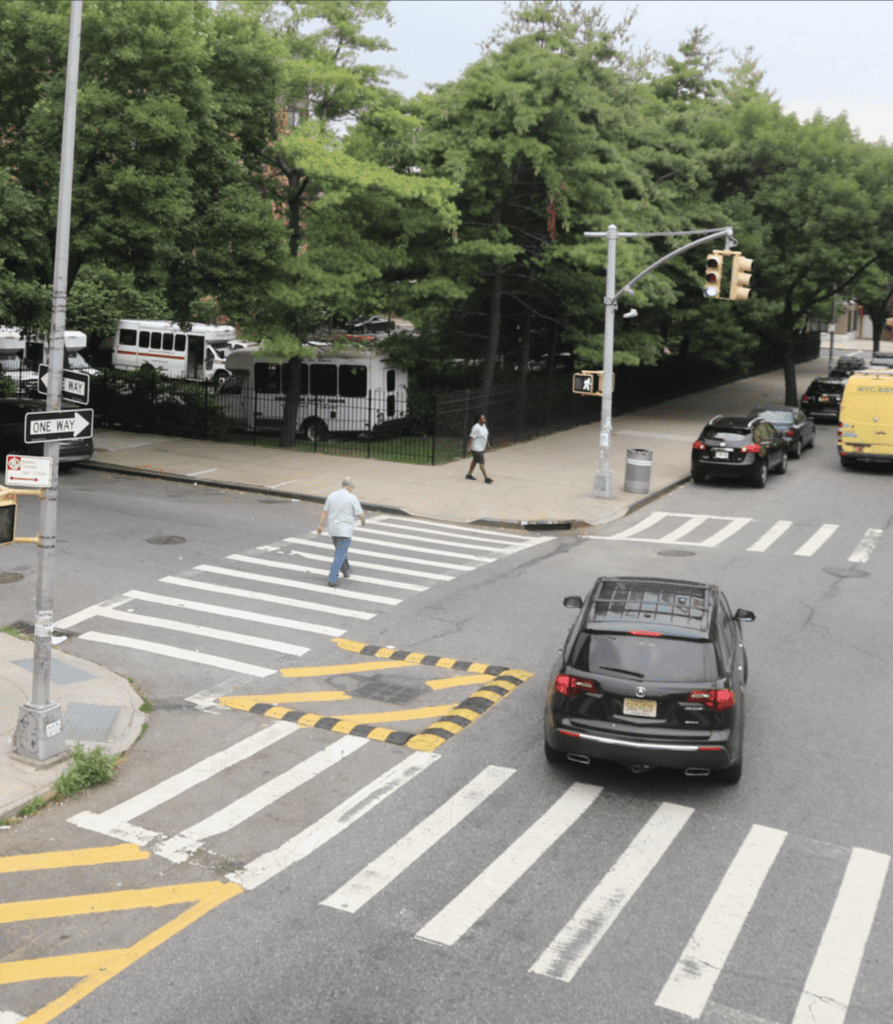
Speed matters, and it particularly matters at intersections where vehicles and pedestrians interact. We want to let you in on a design feature that really matters. Once you see it, you can’t unsee it. And you’ll be amazed/dismayed to see how often corners are designed for speed, not safety, and how it can be fixed.
The connection between corner radii and speed
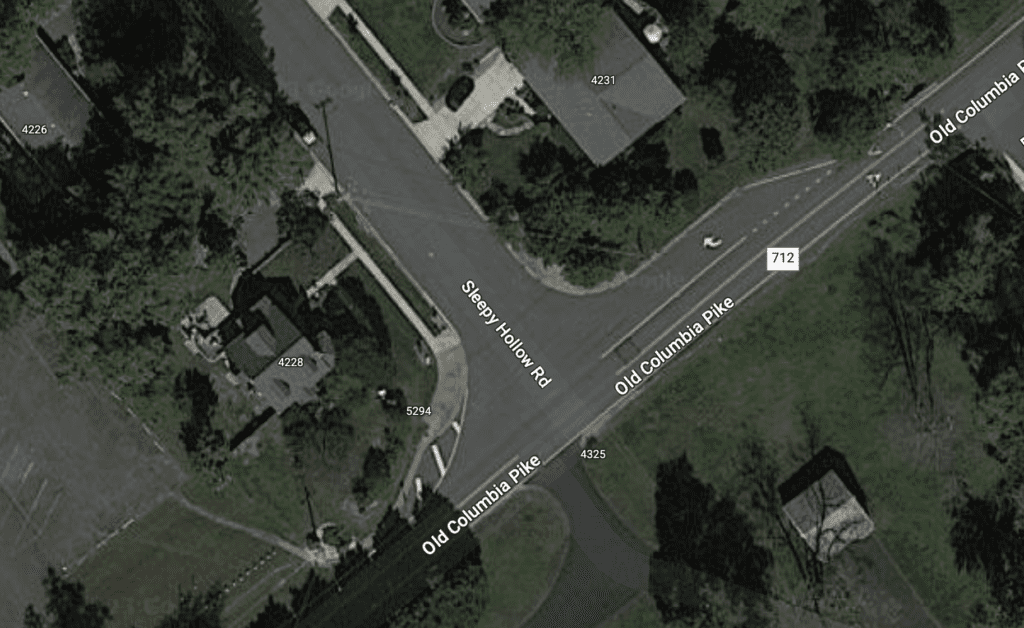
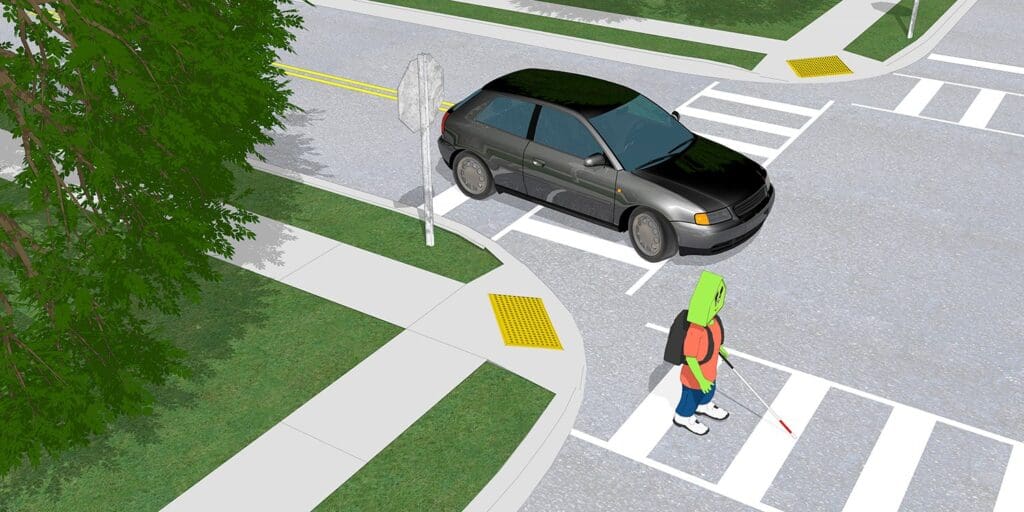
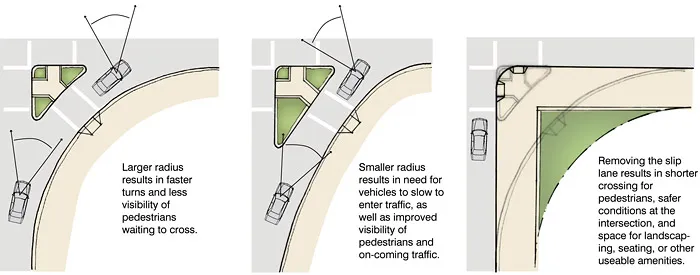
All street corners depend on a design parameter called the “corner radius,” which is the curvature of the corner. The corner radius plays a crucial role in determining the safety of an intersection. Sharp corners have small or tight corner radii. These corners require drivers to slow down to take a turn safely. On the other hand, wide corners have large corner radii and they encourage high speeds when turning.
In many cities and towns, to facilitate turning when driving, intersections have been designed to be wider than necessary. As illustrated in the image below, large corner radii allow vehicles to make a turn without reducing their speed. This creates unsafe conditions for pedestrians as drivers are less likely to yield to pedestrians and drivers have an increased stopping distance, as described in Part 2.
As illustrated in the image below, smaller corner radii require drivers to slow down as they approach an intersection to turn. By slowing down, drivers maintain control of the vehicle and are able to assess pedestrians at a crosswalk, oncoming traffic, and other objects and obstacles as they are turning. If a driver does not slow down, the vehicle may hit the curb or objects near the corner.
Features of wide corner radii
While sharp corners reduce the crossing distance, wide corners create longer crosswalks. The length of the crosswalk can make it difficult for pedestrians to cross quickly and increase their exposure to traffic, including vehicles that are turning. Sharp corners allow for pedestrians, especially older adults, children, or people with disabilities, to cross safely and to ensure they are visible to drivers.
A particularly egregious version of the big radius is the “slip lane” which allows a driver to maintain speeds while avoiding a traffic signal. It is particularly dangerous for pedestrians to cross the unsignalized slip lane given that drivers are maintaining a relatively high speed, and probably looking to the street ahead to time their merge with traffic. The safe and appropriate solution where pedestrians are present is to “square off” the intersection as shown below.
Safety for everyone
Near industrial areas or on designated truck routes, pedestrians may find much wider corners to accommodate for large trucks.1 At times, these designated truck routes go through residential communities, largely in poor communities of color2, creating unsafe walking conditions in these neighborhoods.
Ask your officials
So next time you are talking to a city official, or better yet, the traffic planner/engineer in charge of the street – ask them if they can do something about the corner radius. Or point out the dangers of the slip lane and ask them to close it. Wide radii and slip lanes are examples of design choices that prioritize vehicle speed over the safety of people, inside or outside of cars. Simple infrastructure changes like the ones described above can make a big difference for safety.
Sources
- Truck Safety Considerations for Geometric Design and Traffic Operations
- Diesel trucks are driving environmental injustice in parts of the US
5. Narrowing Lanes for Road Safety: Small Shift, Big Difference
The way we design roads dictates the speeds that drivers adopt, regardless of the posted speed limit. Safe Systems research demonstrates that visual cues from the roadway ahead directly influence how drivers operate vehicles, effectively bypassing the brain.
A surprisingly effective visual cue is just to narrow the travel lanes. Wide lanes may seem like they are safer because they reduce the risk of vehicles drifting out of lanes and causing collisions. While that may make sense on high speed freeways, traffic engineers have mandated wide lanes on many arterial and residential streets with dangerous consequences. Indeed, excessively wide lanes are one reason why multi-lane arterials are the most dangerous road type.
Here’s why it matters. Research has demonstrated that wide straight travel lanes with long sight lines induce high travel speeds. Those speeds can be deadly in the complex environment of cities and towns, which involve driveways, turning vehicles, and most importantly, people using the streets as pedestrians.
Check out this chart which demonstrates the connection between lane width and travel speeds.
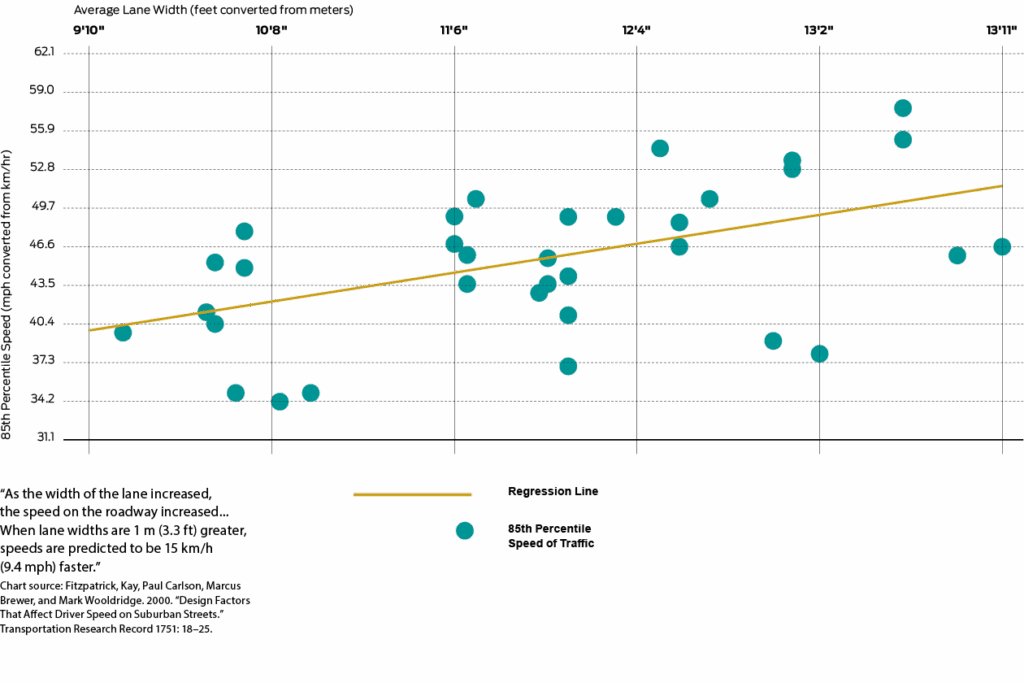
A growing movement over the last two decades has worked to reform traffic engineering practices and to highlight the dangers of excessively wide lanes. The National Association of City Transportation Officials (NACTO) lays out clear recommendations in a design guide on lane width, which we quote here in full:
NACTO lane width recommendations
- Lane widths of 10 feet are appropriate in urban areas and have a positive impact on a street’s safety without impacting traffic operations.
- For designated truck or transit routes, one travel lane of 11 feet may be used in each direction. In select cases, narrower travel lanes (9–9.5 feet) can be effective as through lanes in conjunction with a turn lane.
- Lanes greater than 11 feet should not be used, as they may cause unintended speeding and assume valuable right-of-way at the expense of other modes.
- Restrictive policies that favor the use of wider travel lanes have no place in constrained urban settings, where every foot counts. Research has shown that narrower lane widths can effectively manage speeds without decreasing safety and that wider lanes do not correlate to safer streets. Moreover, wider travel lanes also increase exposure and crossing distance for pedestrians at inter-sections and midblock crossings.
It’s fascinating that just putting the painted lines closer together can have such a positive impact on speed.
Ask your officials
So next time you are advocating for a safer street, ask your local official “what are the lane widths?” If they are too wide, ask why your officials are bringing dangerous highway style design into your community, and share this guide and the above recommendations from NACTO.
Make the case for safer streets
Share this guide with your neighbors, your local officials, and the engineers responsible for your streets. We’re adding new installments over time, so check back, and feel free to share ideas for what we should cover next.

