This blog follows the successful installations of quick-build projects on to make roads safer in three tribal communities, work that was jumpstarted by a roundtable funded by the U.S. Centers for Disease Control and Prevention to discuss tribal pedestrian safety.
In 2022, over 7,500 pedestrians lost their lives on America’s roadways. The tragedy of road fatalities disproportionately affects American Indian and Alaska Native people, who are more than four times as likely to be struck and killed by vehicles while walking.
Speed is a critical factor in whether a collision is fatal. In most rural tribal reservations, vehicles travel at high speeds, and there are usually no sidewalks. Native Americans residing in urban and suburban areas face similar issues with unsafe places to walk.
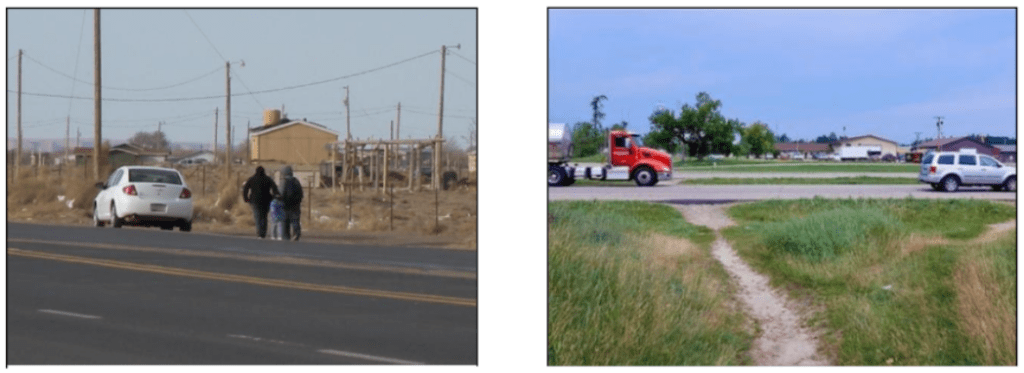
In December 2022, the United States Centers for Disease Control and Prevention funded a meeting to discuss tribal pedestrian safety. The group focused on the following problem statement: Tribal communities are often bisected by county, state, or interstate highways with high-speed traffic, which create safety, health, and quality-of-life problems for residents.
The roundtable jumpstarted critical work in tribal communities. This discussion led to tribal leaders securing new funding from a Road to Zero grant from the National Safety Council to improve pedestrian safety. These efforts included temporary projects, called “quick builds,” which made roads safer by adding in narrower lanes, more visible sidewalks, and visual design elements that slow traffic. The quick builds also involved community investment, as residents of all ages are invited to participate.
Pueblo of Jemez, New Mexico
During a follow-up webinar in 2024, Sheri Bozic, Director of Planning Development and Transportation Department with Pueblo of Jemez, described their efforts to improve pedestrian safety. For the last five years, New Mexico has had the highest number of pedestrian deaths per capita in the U.S. Many people walk along the shoulders of highways, arterials, and side streets, and there is a distinct lack of sidewalks and lighting.
Located between Santa Fe and Albuquerque, the Pueblo of Jemez has a population of 3,900, New Mexico State Road 4 divides the village and poses a serious safety risk.
The Pueblo of Jemez has been working on projects to increase the safety of people walking and biking. In 2024, the Pueblo of Jemez completed the Hemish Path to Wellness, a pedestrian trail next to the highway. Leaders on the project used crash and speed data to show the need for safer walking paths.

Other projects to increase safety for people walking and biking include a quick build on Day School Road, a wide, fast-moving road in front of a Pueblo school that teaches Kindergarten to sixth grade. Students and community members painted planters with flowers to help slow traffic. Since its completion, road speeds, previously two to three times the speed limit, have declined.

They installed radar speed signs to slow down traffic and built monuments at the entrances to the tribal lands to remind drivers to reduce their speed.
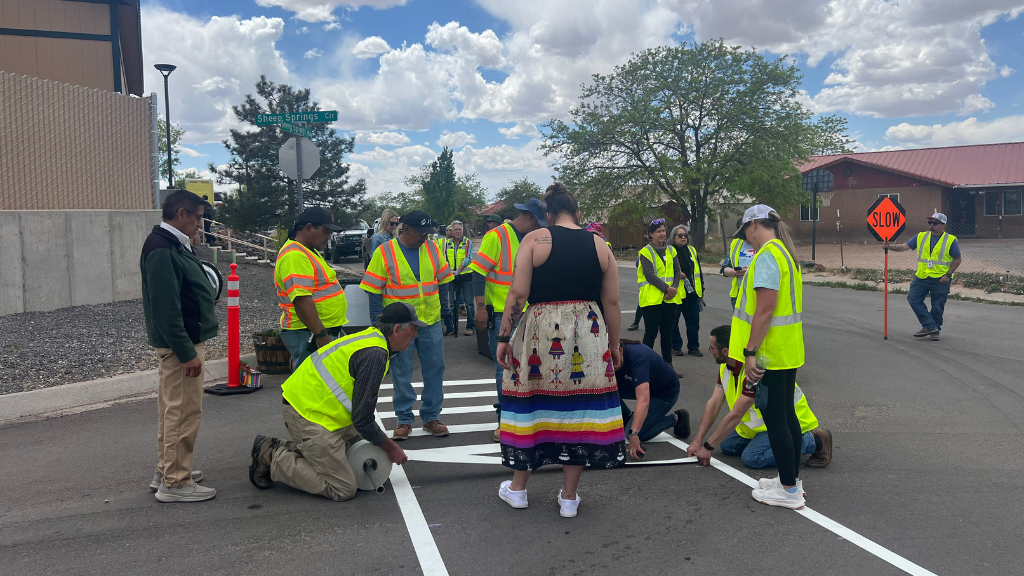
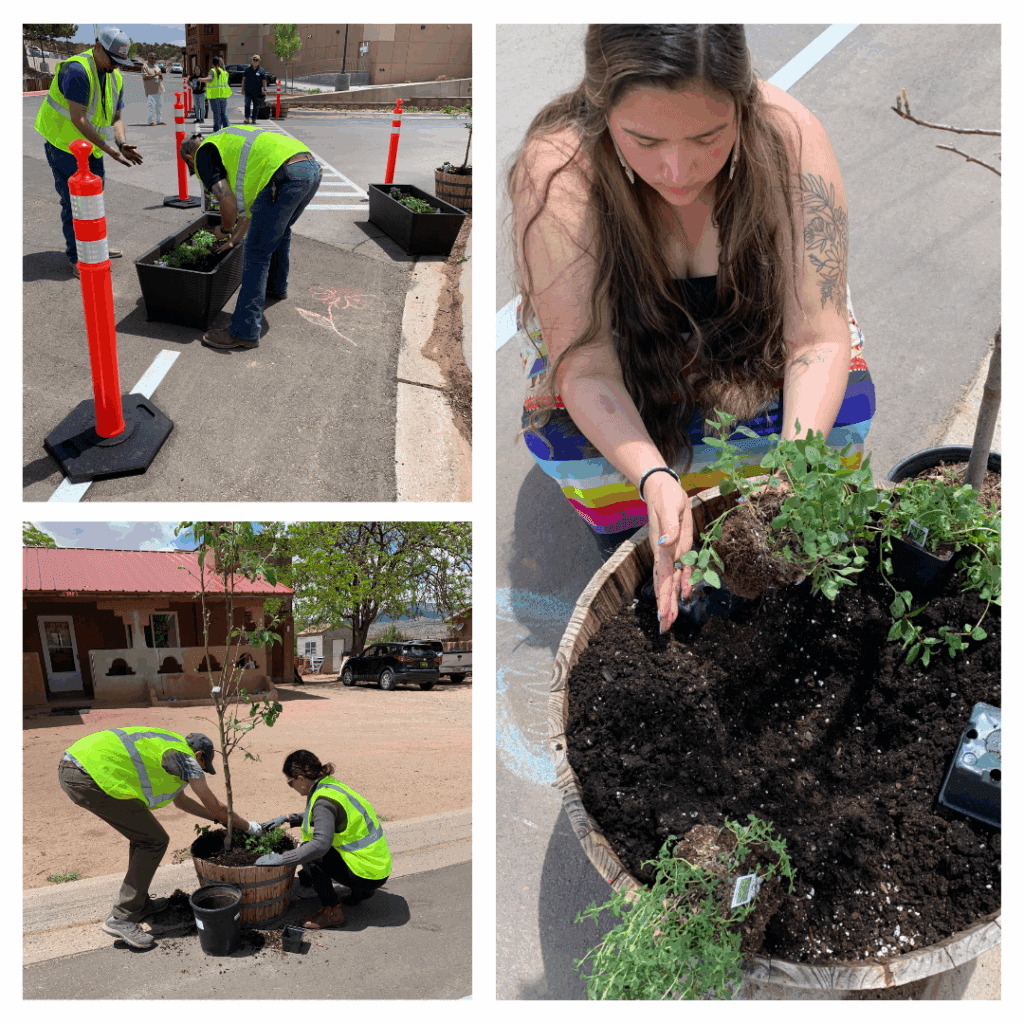
The Pueblo also organized a quick build walking path with two crosswalks along Sheep Springs Circle, a residential “loop” road and the site of frequent complaints about speeding vehicles. In April 2025, dozens of residents gathered for a workshop to complete a community road safety survey and assist with the quick build. Residents, including children from the community, measured and striped crosswalks and installed a protected walking path along the road. Planters and sidewalk chalk art helped to complete the redesign by creating visual elements to slow driving speeds.
During a networking event that followed the workshop and quick build, Arlando Teller, member of the Navajo Nation, Assistant Secretary for Tribal Affairs under President Biden, and former Arizona State Representative, observed:
“The concept of planting for us here in the southwest is sacred:
You plant your legacy,
You plant to eat, You plant to feed,
You plant to commune, You plant to bring family together.
That’s important — so when I heard that, it meant something to me,
That you all got your hands dirty.”
Cherokee Nation, Oklahoma
Hillary Mead, a Primary Prevention Program Supervisor with Cherokee Nation Public Health, focused on Safe Routes to School projects and discussed similar efforts to improve pedestrian safety and mobility on the Cherokee Nation reservation in Oklahoma. The Cherokee Nation has about 140,000 residents spread across nearly 73,000 acres in 14 counties. From 2017-2022, Cherokee Nation experienced 55 fatalities and 260 injuries.
While there are some urban areas, Cherokee Nation is mostly rural. One county is entirely divided by a railroad, with a school on one side and housing on the other, meaning that kids walk across the tracks every day. The general lack of safe places for people to walk makes reaching schools, community centers, grocery stores, and other essential locations extremely difficult and dangerous.
In partnership with the Oklahoma Department of Transportation, and with help from a $500,000 Safe Streets for All grant, Cherokee Nation is working towards improving pedestrian safety. For one high school that uses a field across a fast-moving street with no pedestrian infrastructure for band and football practice, project leaders created new crosswalks to enhance visibility. The project grew from there, leading to the purchase of flashing signage and the successful petitioning of the Stilwell City council to designate the area as a new school zone.
These efforts led to the publication of a Tribal Pedestrian Safety Resource Library, which includes fact sheets, public awareness campaigns, technical toolkits, sample policies, and training programs for communities and professionals.
Confederated Salish and Kootenai Tribes, Montana
The Confederated Salish and Kootenai Tribes Tribal Health Department partnered with the University of Montana to promote physical activity among older adults living on the Flathead Reservation. The Confederated Salish and Kootenai Tribes live on 1.3 million acres of the Flathead Reservation, with 31,000 residents, 8,000 of which are Native American. 22% of those living on the reservation are age 65 or older, which is higher than the national average. Lack of safe places to walk poses a significant safety challenge for these residents.

Maja Pederson, PhD, a Research Assistant Professor with the University of Montana School of Public and Community Health Sciences and a 2021 National Walking College graduate, discussed the project’s approach through the lens of the Growing Older Staying Stronger Initiative, a community-based participatory research project to promote physical activity security among Native American older adults living on the Flathead Reservation. Being able to access safe, enjoyable physical activity not only helps residents meet their health needs — it also helps to promote physical and emotional well-being and social connectedness for an active, healthy life.

In August 2025, quick-build traffic calming projects were implemented in St. Ignatius, Montana, at two intersections. This effort arose from a partnership with the Confederated Salish and Kootenai Tribes and Cherokee Nation. The sites were selected based on community feedback gathered using the Stanford Our Voice public engagement tool. The community came together to create crosswalk art at both quick-build sites, one of which features flowers that are culturally significant to the tribes of the Flathead Reservation.
This publication was made possible by the Centers for Disease Control and Prevention (CDC) (Contract #47QRAA20D003W). Its contents are solely the responsibility of the authors and do not necessarily represent the official views of CDC. These efforts are part of the CDC’s Active People, Healthy NationSM Initiative that is working to help 27 million Americans become more physically active by 2027.