
Every five years, Congress reauthorizes transportation policies and spending levels for the next five years.
With the previous reauthorization set to expire this year (2026), Beth Osborne, President and CEO of Smart Growth America, and Marisa Jones, Policy and Partnerships Director at Safe Routes Partnership, joined Mike McGinn, Executive Director of America Walks, to discuss what the future of transportation looks like.
What’s the Big Deal with Reauthorization?
Every five years, Congress passes a transportation reauthorization bill that sets policy and spending levels for the next five years. It’s not only an opportunity to review past spending and set new spending levels, but also a chance to set the national tone for what sorts of infrastructure projects and investments will be prioritized.
Transportation spending is different from federal spending because it has a much longer time frame, due to the Highway Trust Fund, which was developed to fund building the interstate highway system. In theory, the trust provides reliable, long-term money for major infrastructure projects.
Decades later, the gas tax is woefully inadequate to support the trust, which is now bolstered through appropriations reauthorized by Congress. The last reauthorization was the Infrastructure Investment and Jobs Act (IIJA), or the Bipartisan Infrastructure Law, under the Biden Administration, which created programs to connect historically disadvantaged and underserved communities to jobs and economic opportunities and support climate justice by addressing air quality and tackling climate change.
The federal government provides 20–25 percent of overall transportation dollars. Most of the money goes towards formula funds for each state to use as they see fit, and generally covers 80 percent of highway spending and 20 percent public transit, although there is some flexibility to use highway funds for transit. The remainder is for discretionary grant programs from the U.S. Department of Transportation, such as the Safe Streets for All Grant Program.
If We Do This Every Five Years… How Does It Impact Me?
As Congress goes into the reauthorization process for this year, leaders have admitted that it’s unlikely to happen. Instead, we should expect an extension, which is more likely when there’s not enough money to cover the bills, said Beth Osborne. “We could have seen a similar thing happen before the IIJA, if it hadn’t been sold as an economic rescue package” during the COVID-19 pandemic.
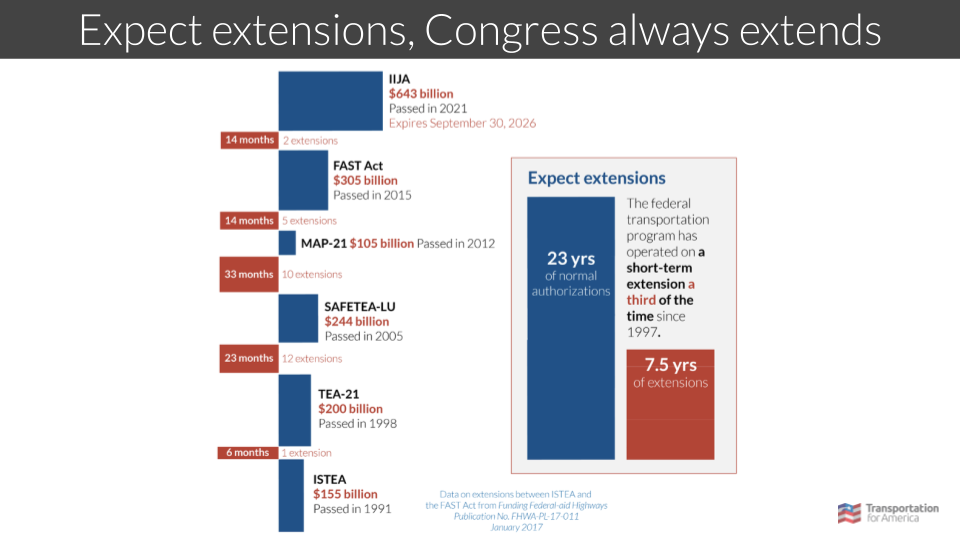
So why care? Well, this is actually when the public has the greatest influence over what happens, since members of Congress are introducing marker bills on specific topics to collect co-sponsors and earn a place in the ultimate reauthorization bill, with enough support.
It’s important that we call on our leaders to prioritize what we want — safe, accessible walking and rolling infrastructure, and more public transportation — from what we’ll get if the current administration, which is already clawing back discretionary grants for climate and equity programs, and showing outright hostility to bike and pedestrian infrastructure, moves forward with the status quo: endlessly expanding highways built for fast-moving cars, not people.
Transportation for America, part of Smart Growth America, has reauthorization 101 and 201 primers to explain how the process works, because, according to Beth, “we can’t wait until the vote happens. That’s just too far down the line. Most of the debate happens as reauthorization bills are being written — and they’re being negotiated right now.”
“Your voice matters, and there are ways to influence this process,” said Marisa, who focuses on building coalitions of local, state, and national organizations together to advocate for policies and programs, such as the Transportation Alternatives Program, that create meaningful change on the ground and are critical to advancing safe, accessible walking and rolling in our communities.
For more — and to hear Beth’s and Marisa’s predictions for the 2026 reauthorization process — check out the webinar recording below.
For more, watch the whole webinar here!
Additional Resources
- Transportation for America: Reauthorization 101 Primer
- Transportation for America: Reauthorization 201 Primer