At America Walks, we believe in giving safety the priority it deserves in street design, rather than prioritizing the speedy movement of vehicles. So what are the best ways to redesign existing streets for safety?
During a recent webinar, Jeremy Chrzan, Multimodal Design Practice Lead at Toole Design, joined Abdullahi Abdulle, Founder and CEO of Humanize MN and America Walks Board Member, to discuss current best practices and evolving trends in street design.
Here are our top takeaways:
We must address current road safety challenges while also taking a proactive approach to creating safer streets for everyone.
Nearly 41,000 people died on United States streets in 2023, and millions are injured each year. While pedestrian and motorist deaths slightly reduced from 2022 to 2023, it’s clear that we need to address road safety to prevent further loss of life.
Jeremy emphasized a Safe System Approach to street design, as well as improving culture around the idea of safety from the roadway design perspective to prioritize safer, slower roads. Improving vehicles and training for everyone using our roads is also critical.
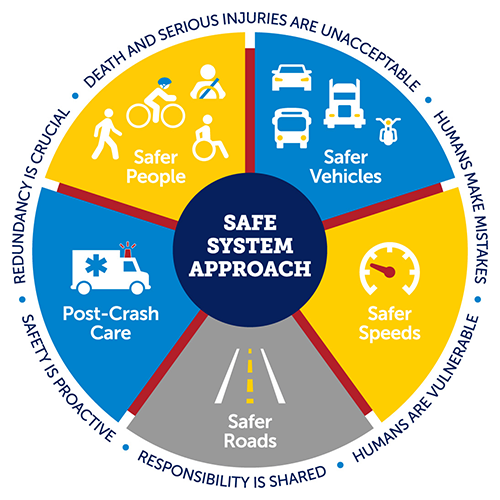
But it’s not enough to address existing issues alone. We need to take a proactive approach to road safety. “We shouldn’t be waiting to address safety after somebody dies,” said Jeremy.
The size and design of motor vehicles impacts overall road safety.
Jeremy noted that the increase in size and weight of vehicles means larger blind spots and the tendency for crashes to be more severe or fatal.
This issue isn’t limited to personal vehicles. Departments of transportation and local agencies own and operate large fleets that include emergency service vehicles, sanitation vehicles, and buses. According to Jeremy, these agencies can help make roads safer by being deliberate about the types of vehicles they purchase.
Beyond that, we can also influence what types of vehicles are used for roadway construction and deliveries to create safer, more walkable communities. For instance, local agencies can specify that larger commercial and municipal vehicles have side guards to reduce the likelihood of pedestrians or cyclists being pulled under in the event of a crash.
America Walks’ Safer Vehicles for Pedestrians campaign includes our Safe Streets Challenge, which calls on governments to lead by example and show their commitment to safety by retrofitting fleets to follow speed limits.
Street design is a key element to building safer, more walkable communities.
When it comes to addressing the number of fatalities and injuries on our roadways and prioritizing safety, we need to think critically about how we design our streets.
Street designers and traffic engineers typically cite sources such as the American Association of State Highway and Transportation Officials’ (AASHTO) Green Book, both as an influence in their designs and a reason why certain changes can’t be made. “Too many engineers,” Jeremy said, “use this guide as a detailed manual of standards, even though it explicitly says not to do that.” In reality, the AASHTO suite of design guides provides designers flexibility to tailor their work to a project’s particular context and established goals.
Notably, smaller interventions on existing streets can have a significant effect on safety, such as narrowing lane widths in urban spaces to slow vehicles and reduce the severity of crashes. Add in increased sidewalk widths, more accessible transit stops, and appropriate buffers between the curb and pedestrians, and the impact of these shifts is amplified.
Developing public space to be more inviting should be a perspective in safe street design. Including street furniture, landscaping elements, curb extensions, and pedestrian-scale lighting can make a big difference in increasing that pedestrian activity, which encourages slower, more careful driving.
You don’t have to be a technical expert to advocate for safer street design.
While the overall webinar was geared towards street designers, Jeremy and Abdullah also mentioned tools advocates can use when discussing streets with your local and regional agencies.
Many state and local agencies have encapsulated pieces from sources like the Green Book in their own agencies’ design guidance. However, sometimes that guidance is more restrictive than what the Green Book intended.
These published sources and guidebooks can also be hard to come by outside of the professional transportation space. That said, executive summaries and conclusions attached to research are often freely available and easily digestible for non-professionals.
If you’re an advocate, keeping up with what’s fresh is critical to catalyzing change. Consultants and firms working on these types of projects sometimes post information about recent research and updates to guidelines on their social media. Similarly, following your local agencies’ on social media may open the door to further community involvement.
Street design and taking a proactive approach are necessary for addressing the road safety epidemic in the U.S. Whether you’re a transportation professional or a local advocate, your voice matters in this conversation.
For more, watch the whole webinar here!
Additional Resources
- A Policy on Geometric Design of Highways and Streets, a.k.a. the “Green Book” (Federal Highway Administration, Department of Transportation)
- The National Cooperative Highway Research Program
- National Association of City Transportation Officials’ Urban Street Design Guide
- An Introduction to Building Safer Streets (America Walks)
- Achieving Multimodal Networks: Applying Design Flexibility and Reducing Conflicts (Federal Highway Administration, Department of Transportation)