Nearly 40,000 people were killed on America’s roads in 2024, including over 7,000 struck and killed while walking. While the number of pedestrian fatalities has declined slightly from a 40-year high a few years ago, there is so much more we can do to improve road safety in our communities.
During a recent webinar, Heidi Simon, Director of Thriving Communities at Smart Growth America (SGA) and Colin Alexander, Program Manager for the Birmingham Department of Transportation, joined America Walks’ Policy Director Ben Crowther to discuss how we can achieve long-term systems changes for road safety through near-term wins at the federal, state, and local levels.
Pedestrian and Road Safety: A National Challenge
Framing the conversation with a national approach to traffic safety, Heidi Simon introduced SGA’s landmark 2026 Dangerous By Design report, which looks at pedestrian fatality rates using 2024 data across the U.S. Although 2024 saw a modest decrease in the number of people struck and killed while walking from the last two years, overall fatalities have increased by 72% since 2009.
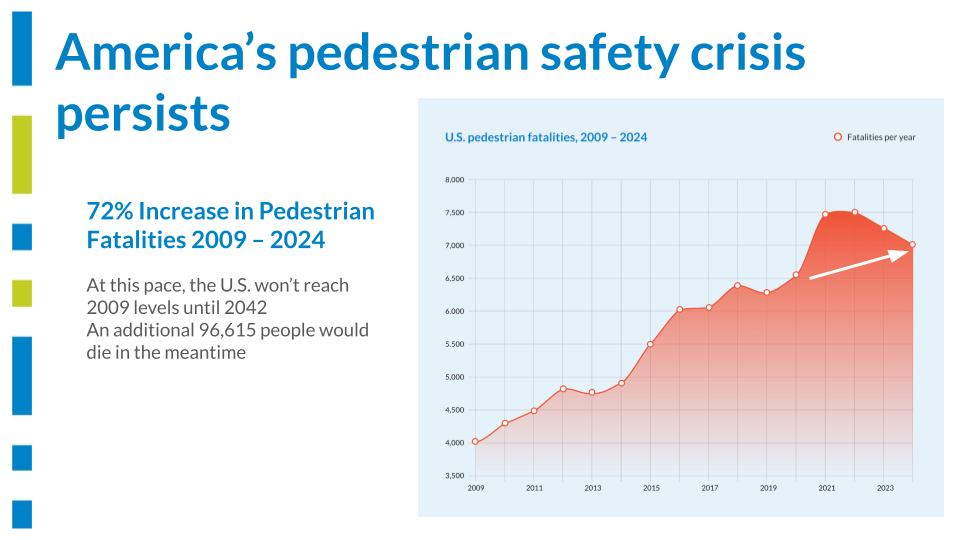
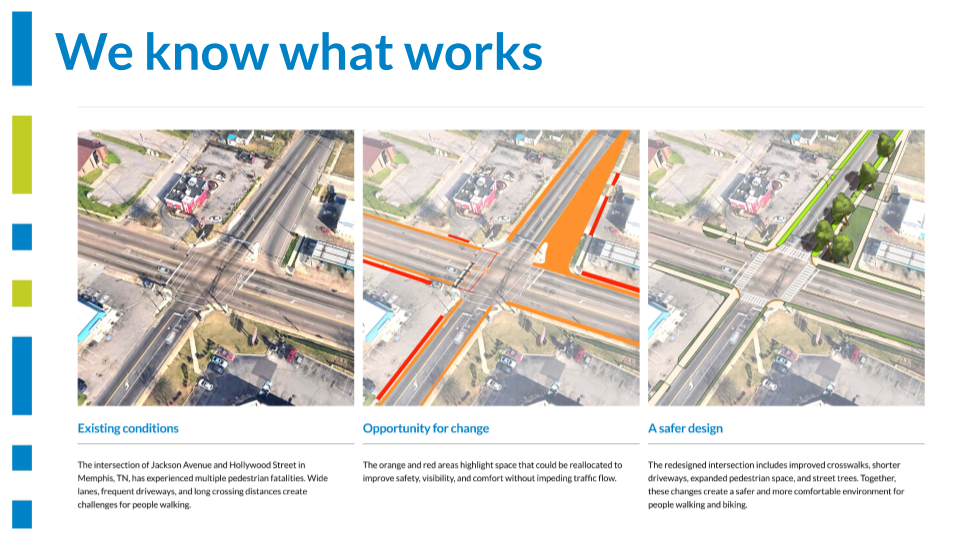
The top deadliest states and metro areas are located in geographical areas with fewer safe places for walking. Memphis, Tennessee, for example, continues to hold the top pedestrian fatality rate among metropolitan areas and is seeing increased and more frequent fatalities. 19 of the 20 most dangerous states for pedestrians made no progress from the last report released. And even Delaware, which reduced pedestrian fatalities more than any other state, is still the 10th most deadly.
“The status quo isn’t working,” said Heidi. “We need something different when it comes to federal transportation policy.”
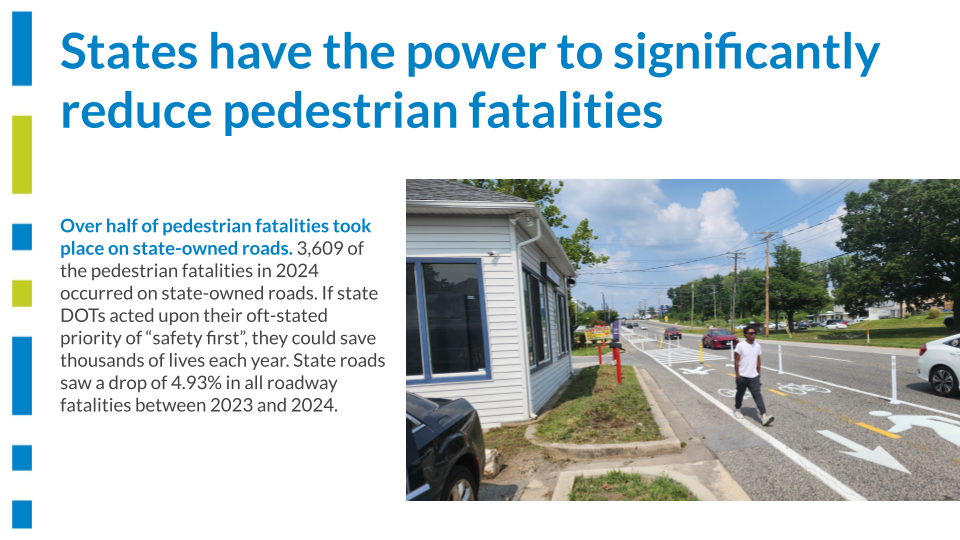
States have the power to significantly reduce pedestrian fatalities by changing the ways our streets are designed through policies and creative funding sources. They also can partner with local communities to find place-based solutions that work for everyone.
We can look to our global peers for inspiration, too. Dangerous By Design found that, compared to 34 peer nations—most of which made strides in road safety—the pedestrian fatality rate in the U.S. increased by 45% in 2024.
Finally, we know what works for building safer, more walkable streets and communities. These interventions save lives and make our communities safer, more enjoyable places to walk, roll, and bike.
Thinking Creatively: Birmingham, Alabama’s Journey to Safer Multi-Modality
For a deep dive into place-based approaches to traffic and pedestrian safety, Colin Alexander joined from Birmingham, Alabama, a late-19th-century steel town built on a walkable urban core. The mid-20th-century, however, saw the removal of the city’s extensive streetcar network, with money going to build roadways. The city also created a Department of Traffic Engineering around that time to move as many cars as fast as possible. All of which resulted in Birmingham being among the country’s leading metropolitan areas in pedestrian-vehicle incidents.
But Birmingham has been making strides in laying the groundwork for safer multi-modality. In 2015, the city’s comprehensive plan identified transportation policies Birmingham should adopt, and, in 2017, the incoming mayor reorganized the Department of Traffic Engineering as a Department of Transportation (BDOT). BDOT hit the ground running, galvanizing a robust group of supporters to lead the way for adoption of a 2018 complete streets ordinance. By 2024, Birmingham became the first city in the Deep South to eliminate parking minimums in zoning codes.
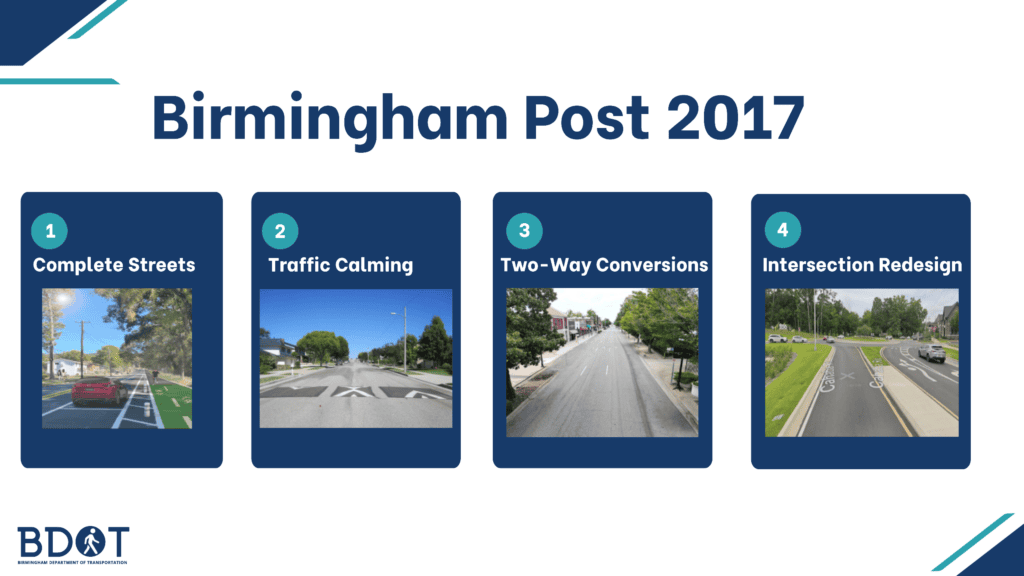
The city’s complete streets focus allows BDOT to focus on improvements with every transportation capital project it develops. For instance, BDOT has added 20 miles of bike lanes since 2018. The city has prioritized the following areas:
- Traffic Calming: Until 2020, Birmingham automatically denied traffic-calming requests. In 2020, BDOT launched a traffic-calming program that was immensely popular. Since then, about 100 streets have undergone street-calming strategies, and BDOT uses a grassroots and technical joint-partnership model that includes coordinating on design solutions and splitting costs with neighborhoods.
- Two-Way Road Conversions: In the 1970s, one-way roads replaced two-way roads in Birmingham’s downtown grid to funnel traffic to the interstate system. One-way roads are significantly more dangerous, and the city has undertaken conversions to reduce the frequency and severity of crashes, reduce speeds, and reduce crime.
- Intersection Design: Birmingham regularly works safety elements, like sidewalk extensions, radii tightening, roundabouts, complete network redesigns, and updating traffic signals into routine projects.
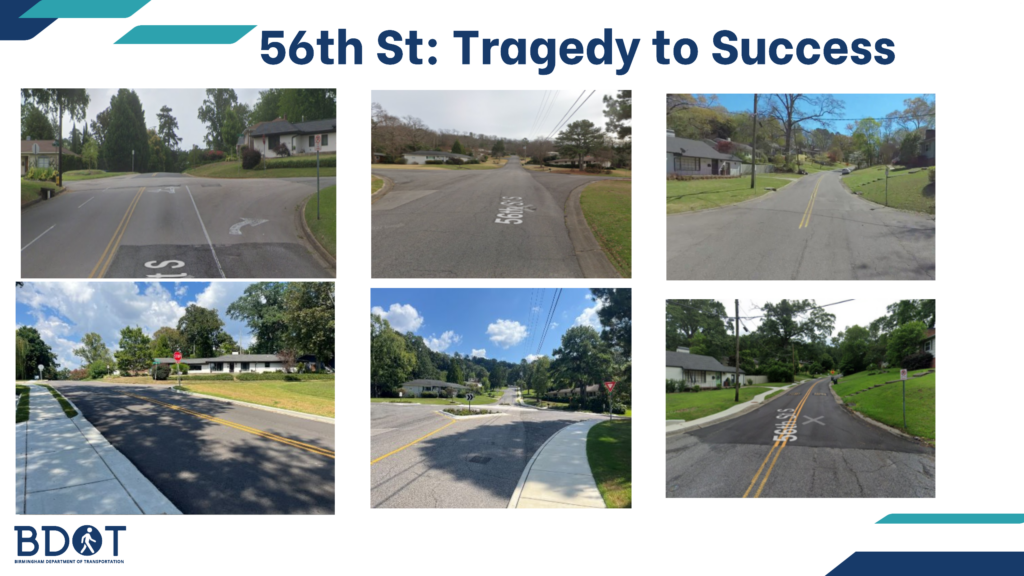
Colin shared the case of 56th Street, which connects two neighborhoods bisected by a state highway—and has very little walkability, despite the community calling for traffic-calming measures and sidewalks. On Halloween of 2023, a speeding driver struck a child at an intersection. The child survived but continues to have health problems. As a result, the city responded with a temporary traffic-calming measure, leveraging American Rescue Plan Act funds to build a sidewalk and expand the scope of that project to permanently redesign the intersection.
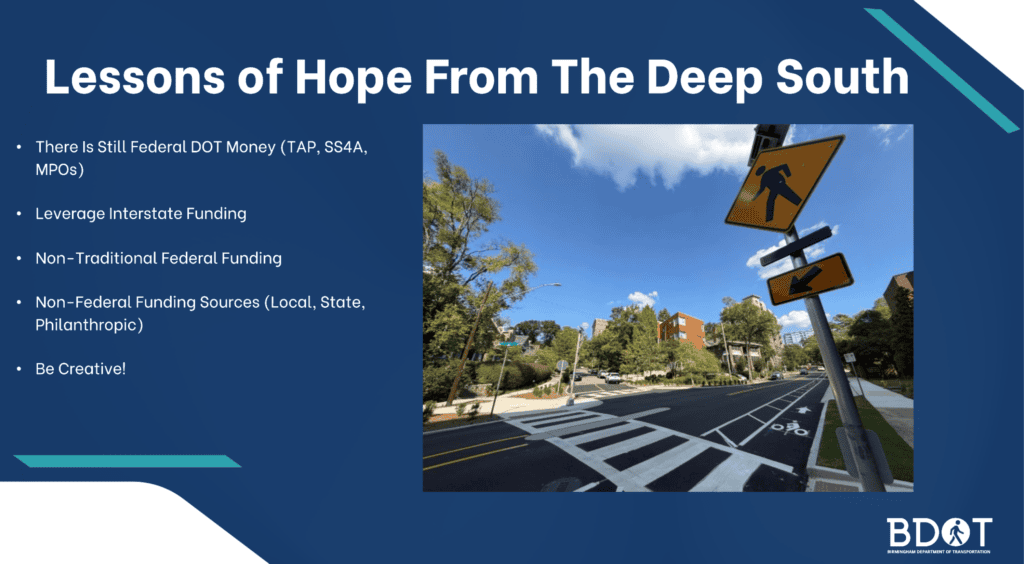
Colin offered some lessons to help you systematically advance walkability and traffic safety in your community:
- Leverage federal money from the U.S. Department of Transportation (including the Transportation Alternatives Program (TAP), Safe Streets for All (SS4A), and funds allocated to Municipal Planning Organizations
- Use interstate funding to make improvements where highways tie into the local road network (ex: make interstate off-ramps safer)
- Look for non-traditional federal funding sources, as well as local, state, and philanthropic sources to advance your community’s goals
- Be creative! For example, find ways to tighten turn radii with concrete and fixing sidewalks while repaving roads
- Don’t underestimate the importance of local policy improvements
Flexible Solutions & Storytelling for Change
During the Q&A session, Heidi and Colin joined Ben in a discussion on topics such as the role of lower-lift interventions versus capital-intensive street redesign projects.
While things like paint and flex posts can increase awareness for bicyclists, Heidi helpfully reminded us that “paint is not protection. Projects that create dedicated, protected road space can take five, ten, fifteen years” to make happen—and we don’t have that kind of time. She and Colin supported embracing flexibility through stop-gap measures, pilot projects, and quick-builds to start the process and move quickly.
“It’s a step forward, not a one-and-done measure,” said Colin, “And it sets the stage for us to go after and implement harder barriers” to protect bicyclists and pedestrians. These small improvements also communicate to residents that their city cares about the issue and is willing to get involved.
When it comes to addressing pushback from community members and local agencies, Colin emphasized the use of data to make the case for shared values like improved public safety, health outcomes, and economic activity.
However, data doesn’t tell the full story. “Stories matter,” said Heidi. Both she and Colin encouraged combining data with stories from communities to increase impact and bring a broader coalition of local supporters to the table to make a difference.
Additional Resources
- The Best Complete Streets Policies 2025 (Smart Growth America)
- Complete Streets, Stronger Economies: How Safer Streets Support Economic Growth (Smart Growth America)
For more, watch the whole webinar here!
This publication was made possible by the Centers for Disease Control and Prevention (CDC) (Contract #47QRAA20D003W). Its contents are solely the responsibility of the authors and do not necessarily represent the official views of CDC. These efforts are part of the CDC’s Active People, Healthy NationSM Initiative that is working to help 27 million Americans become more physically active by 2027.